


My friend Geirmundr wonders whether there is a convenient source with a description of what a 14th century soldier of good rank, say a captain of a mercenary company or someone similar, would have as possessions while on campaign. He wishes to assemble such items, or reasonable facsimiles thereof, more systematically. When we first discussed this, I suggested that I was not sure there was such a source. 14th century studies are regrettably few, and the serious stuff in print tends to start with the Wars of the Roses. However, I suggested that we could in fact assemble a reasonable list of sources that would allow us to piece together a list, especially if we make some cautious assumptions about 15th century gear that would have been around in the 14th century.
Candidly, this is a topic I would have had a readier set of answers for ten or fifteen years ago, as I am a little separated from the topic now. At some point when I have time and access to a research library, perhaps later this month, I know where to look for more material.
Of course, his project interests me, as well, but at any rate, here are my initial thoughts on some potential sources, keeping in mind that clothing and armor are easy and not really what he is looking for.
Caselli, Giovanni. History of Everyday Things: The Middle Ages. This is a beautiful hardcover children's book. It has many handsome and accurate drawings of surviving or pictured medieval artifacts. Like many recent children's books, this is really quite good. Doesn't quite nail our topic, but pages 38-39 might be of particular interest. Lots of diagrams of carpenters and architects tools, that sort of thing.
Clare, John D, ed. Living History: Fourteenth-Century Towns. A children's picture book, staged with recreationists or at least a recreationist's sensibility. Some nifty scenes and props, but not quite up to the Eyewitness Books standards.
Coss, Peter and Maurice Keen, eds. Heraldry, Pageantry and Social Display in Medieval England. Dress and Social Status in England before the Sumptuary Laws by Frederique Lachaud at p. 105 looks interesting, and there is some good stuff in Chivalry, Pageantry and Merchant Culture in Medieval London by Caroline Berron at p. 219.
Crossley-Holland, Nicole. Living and Dining in Medieval Paris: The Household of a Fourteenth Century Knight. This is obviously of great interest. When I read it years ago, I was focused entirely on food and recipes, with which this volume is massively concerned, but it is worth a look, despite the fact that it is about a peaceful household rather than a camp.
Embleton, Gerry. Medieval Military Costume Recreated in Colour Photographs. Useful, especially for camp scenes posed by European recreationists. All the good stuff is in the 15th century, I'm afraid. Embleton's other book is more useful for that.
Embleton, Gerry and John Howe. The Medieval Soldier. This is much better, with many more scenes of camp life. Unfortunately, it is out of print and not to be had for less than a small fortune. Inter Library Loan is recommended for this one. I wish I'd bought a copy years ago.
Hinton, David A. Gold and Gilt, Pots and Pins: Possessions and People in Medieval Britain. Not as interesting as it sounds, I'm afraid, but worth a look, and it has a very extensively bibliography, which I will have a look at before the aforementioned library trip.
Langley, Andrew. Medieval Life. This is an Eyewitness book essentially geared for young people. As such, much better for our purposes, because it actually shows pictures of clothing and everyday items usually overlooked by more scholarly sources. And based on my observation, the Eyewitness series has a pretty high standard of scholarship, certainly high enough for recreating medieval objects for use in the SCA. Excellent and helpful stuff throughout, though not much specifically focused on the medieval nobleman or soldier in camp. Definitely helpful, though. The version I've linked to might be a revision - I've seen it but haven't actually checked to see whether there are changes.
Singman, Jeffrey L. and Will McLean. Daily Life in Chaucer's England. This is a book published about a decade ago by some Canadian recreationists, so it is very much the sort of thing one might find useful in the SCA. Not precisely on the money, but lots of details very close to what Geirmundr is seeking. The authors discuss coinage, food, clothing and accessories, all the usual topics. Of particular interest might be Chapter 5 on the Living Environment.
Wolfegg, Christoph Graf zu Waldburg. Venus and Mars: The World of the Medieval Housebook. A beautiful pictorial description of a 15th century volume full of drawing of medieval people and objects. Gorgeous to look at, this would bear very close examination, which I lack time for at present. Definitely interesting scenes of groups of people dining al fresco.
More, probably much more, later.
Saturday, November 04, 2006


Thursday, October 26, 2006
More Comments on Awards
Anonymous comments on my previous post, noting that Maya of Talonvale also was inducted into the Order of the Willow at Crown. Hoobah to her, too!
He also suggests that it may be necessary to just wing nominations during a reign in which we may be unlikely to see a local event, and that after all some Stormvale members don't often go to events. This I have a perhaps unwelcome answer for, which may date me to the prehistoric age.
It has always been the assumption, even back when the Middle was a much larger kingdom, that if you wanted someone to get an award, you nominated them based on the assumption that they would appear at certain events. Of course this was always hit or miss. But if you were trying to nominate someone who didn't really attend events but was entirely active locally, you either waited for the golden opportunity at Pennsic or a very close-by event, or you didn't nominate them.
And if the reigning monarchs hold their courts in the Midlands (Illinois) for the most part, and you have court business to conduct, or you want to kindly ask them to do something for you, like give an award to someone you recommend, then going to the Midlands is the option. One can't just shrug off the realities of the size of the kingdom. Besides, the next king and queen will be from Pentamere, so we're only six months away from more convenience in this regard.
Our options for this reign, conventionally:
1. Wait for the royalty to add Pentamere events to their schedule. They likely will.
2. Organize some trips to Midlands events if you really want someone to get an award.
3. Wait for the next reign.
4. Don't make the nomination at all.
The royalty in recent reigns has been very generous about giving awards to Stormvale members who don't show up for court. That's good of them, but it really isn't the best practice to keep making nominations with that assumption in mind. Again, it may make me a dinosaur, but in the old days we didn't make nominations this way. Active members of the SCA should show up in court every now and again. It's strange if they don't. That's our problem, not a systemic problem.
He also suggests that it may be necessary to just wing nominations during a reign in which we may be unlikely to see a local event, and that after all some Stormvale members don't often go to events. This I have a perhaps unwelcome answer for, which may date me to the prehistoric age.
It has always been the assumption, even back when the Middle was a much larger kingdom, that if you wanted someone to get an award, you nominated them based on the assumption that they would appear at certain events. Of course this was always hit or miss. But if you were trying to nominate someone who didn't really attend events but was entirely active locally, you either waited for the golden opportunity at Pennsic or a very close-by event, or you didn't nominate them.
And if the reigning monarchs hold their courts in the Midlands (Illinois) for the most part, and you have court business to conduct, or you want to kindly ask them to do something for you, like give an award to someone you recommend, then going to the Midlands is the option. One can't just shrug off the realities of the size of the kingdom. Besides, the next king and queen will be from Pentamere, so we're only six months away from more convenience in this regard.
Our options for this reign, conventionally:
1. Wait for the royalty to add Pentamere events to their schedule. They likely will.
2. Organize some trips to Midlands events if you really want someone to get an award.
3. Wait for the next reign.
4. Don't make the nomination at all.
The royalty in recent reigns has been very generous about giving awards to Stormvale members who don't show up for court. That's good of them, but it really isn't the best practice to keep making nominations with that assumption in mind. Again, it may make me a dinosaur, but in the old days we didn't make nominations this way. Active members of the SCA should show up in court every now and again. It's strange if they don't. That's our problem, not a systemic problem.
Wednesday, October 25, 2006
Stormvale Awards
Several awards have been made to Stormvale members in recent weeks:
Vikings Come Home, Donnershafen:
A'isha al-Zarqa, Order of the Willow
Crown Tourney:
Andrew Fowler, Award of the Acorn
Eron Crowfford, Order of the Willow (this is a mistake, she is already a member)
Maryska of Stormvale, Award of the Purple Fret
Lady Femke, the Regional Signet, was kind enough to pick up the scrolls at Crown. None of our awardees were present at either event. This might be a good time to remind those making award nominations that it is not the best practice to make award nominations for specific events unless you're reasonably sure there's a good chance that the nominee will be there to be recognized. Right now, Stormvale members go to Pentamere events and Pennsic for the most part.
Vikings Come Home, Donnershafen:
A'isha al-Zarqa, Order of the Willow
Crown Tourney:
Andrew Fowler, Award of the Acorn
Eron Crowfford, Order of the Willow (this is a mistake, she is already a member)
Maryska of Stormvale, Award of the Purple Fret
Lady Femke, the Regional Signet, was kind enough to pick up the scrolls at Crown. None of our awardees were present at either event. This might be a good time to remind those making award nominations that it is not the best practice to make award nominations for specific events unless you're reasonably sure there's a good chance that the nominee will be there to be recognized. Right now, Stormvale members go to Pentamere events and Pennsic for the most part.
Saturday, October 21, 2006
The MidRealm's New Prince and Princess
The new prince is an old prince. His Grace Dag Thorgrimsson has won the Crown Tourney for the fifth time, a record in the Middle Kingdom. Anything over two reigns is quite unusual. Dag won the tournament for the honor of Lady Anne Marie de Garmeaulx. He defeated Captain Sascha St. Martin, who fought for Lady Lauren of Arabia.
Dag reigned twice with Ilsa von Westfal, and twice with Elayna Lilley. This will be Anne Marie's first time on the throne.
His Grace (His Highness, now) has always been popular in Stormvale. He won his second Crown in Stormvale in 1992, and was kind in various ways to us some years ago. He came to one of our very tiny events the weekend after winning his first Crown tourney, despite having much more glamorous offers, and even marshalled our tournament. We will certainly never forget that.
Dag is also notable for his great dignity and sense of kingliness. I have often seen him being unusually gracious and generous with his time when reigning, as well. He sets a good example in that regard. So, from my perspective, this is news to gladden the heart.
Dag reigned twice with Ilsa von Westfal, and twice with Elayna Lilley. This will be Anne Marie's first time on the throne.
His Grace (His Highness, now) has always been popular in Stormvale. He won his second Crown in Stormvale in 1992, and was kind in various ways to us some years ago. He came to one of our very tiny events the weekend after winning his first Crown tourney, despite having much more glamorous offers, and even marshalled our tournament. We will certainly never forget that.
Dag is also notable for his great dignity and sense of kingliness. I have often seen him being unusually gracious and generous with his time when reigning, as well. He sets a good example in that regard. So, from my perspective, this is news to gladden the heart.
Monday, October 16, 2006
Feast After Action Report
There are times when I don't really feel like I have time for the SCA, and when I become impatient with tasks I've agreed to perform and can't readily get out of. Sometimes it feels like an imposition on time I need to spend on work, other hobbies or watching the Tigers win the pennant.
But as much as I rather dreaded having to devote half of Friday and all of Saturday to the Harvest of Souls VI feast and Sunday to recovering, I will admit that it was fun. Working with Lady A'isha al-Zarqa on a feast is always delightful, and getting the report that she received a Willow at the recent Donnershafen event after the feast was very nice and good timing.
We had the easiest time in the kitchen I can remember, no doubt because while A'isha and I make a good team, adding Lord Diego Brasa de Zaragoza (former caterer) and Her Ladyship Clarissa Wykeham (a past head cook for Stormvale) to the crew made a 14 dish feast remarkably easy. We had a pleasant and relaxing time in the kitchen, despite the hard work at times, and it was especially nice to know that any one of the four of us could adopt any task or dish, or switch off without fuss. And as always we could rely on His Lordship Skalla-Geirmundr Ulfsson to do various hard and thankless tasks, like processing all the onions and washing 90% of the dishes, and Mistress Melisande of Woodcrest, who ran errands. And as he often does, Lord Gerard von Lowenstein ramrodded the servers and made it so the cooks had to do little or nothing with the actual service of the feast. And we appreciated all the other folks who lent a hand, especially on clean up after the feast.
It may be a first, but when we were ready to go with the feast on time (the first two courses were plated and ready to go by then), the feast hall was not fully cleared, and there was a delay while we just kept getting farther ahead. That was quite agreeable.
The Virtues and Sins theme worked out fine, I thought, although it was a rather expensive proposition when we were comping so many tickets and couldn't count on selling out, which we didn't. But the expense wasn't so very far over our usual, everything considered, and it is nice to pull out the stops every now and then.
A few comments on the dishes, with credit to the cooks involved:
Diego was responsible for roasting and slicing the beef for Sauce Aliper, for the Pies of Paris, with a little assistance from A'isha and Clarissa, for the Risotto (he had made the chicken stock for that during the week), and for assisting with the Pippin Pudding prep. He also helped reconstitute some of the Herb Soup when it looked like we might run out. And all this while teaching a class on chain mail and even sitting down for a few minutes of the feast. The beef was fantastic (A'isha and I both snuck pieces before it left the kitchen), the pies looked gorgeous and were highly praised, and while I didn't try the risotto, it smelled divine. I should add that Diego, a former kitchen professional, knew how to operate both the convection oven, which was very handy, and the industrial-grade garbage disposal, which was a great help during clean up. We would have ignored both pieces of equipment otherwise.
Clarissa was responsible for the Pippin Puddings, and invented a clever new way to arrange them for cooking which we will certainly adopt ever after. They were in the seventh and last course, which meant there was some danger they would be refused (and I allowed Clarissa to assume an earlier, smaller number of apples for just that reason - she cooked 70 instead of the 91 planned servings), but in fact very few of them came back. Melisande and I ate some of the leftover custard, and thought it superb. Clarissa also prepped the carrots for another dish, gilded most of the chicken and generally helped with many other tasks.
A'isha, as I have mentioned before, is my favorite partner in the kitchen. Aside from a few moments of discussion at the outset, we really didn't need to plan much or discuss division of labor. We both just floated around keeping things caught up. She was responsible for the Tarts on Ember Day, which were especially glorious and buttery, the Soul Cakes, which she cooked ahead of time, the relish trays and the Herb Soup. She also did some of the more tiresome tasks, like prepping the egg yolks, of which we needed an absurd amount, and had the clever idea of using the fennel greens for garnishing the fish. I should add that both the tarts and the herbs for the soup were quite prep-intense, and A'isha probably helped with all of the dishes, and especially with getting them plated and out the door. I think she and Diego washed and sliced the radishes, too, but I was busy with something else at the time, so I'm not sure about that part.
I roasted the Gilded Chicken, cooked the Apecian Carrots, parboiled and steamed the Broccoli and Fennel, and did the Sauce Cameline for the fish. A'isha and I did most of the plating and arranging as the dishes were going out, with much help from Diego and Clarissa. And Geirmundr also helped with the eggs, butter, and prepped the Compound Salat.
I heard no complaints about any dishes (other than from Geirmundr, who thought I was adding too much odd stuff to the salad!), and I would account this a very successful feast just on that account. We all thought the gilded chicken was something of a revelation. And I thought the tarts and pies had never looked quite so good, and both got many compliments. And the Pippin Puddings came off beautifully.
Once everything was out, and we had been graciously applauded by the diners, the cooks drank champagne in the kitchen (later shared with lunch taverner Lady Eron Crowfford and Geirmundr), and enjoyed some of our cooking. To my surprise, Volkmar, a colleague from work, brought us two beautiful bottles, complete with heraldry, of kiwi lime mead! We promptly opened one and enjoyed it. Most delicious. Limes improve everything, in my view.
At roughly this time we were finding out that A'isha had received a Willow and that the Tigers had won the pennant, and the evening wound down. There was some discussion of doing it again next year, and unless someone else wants a turn or the event stewards have had enough of me, I expect we'll have to. A'isha flatters me with the suggestion that she won't if I don't, and that's pretty convincing!
One last set of comments: the promised Bourbelier de Sanglier dish (pork loin) had to be dropped for roast beef in sauce aliper at the last minute, when it developed that no one had pork loin on sale. There usually is a sale somewhere, but the beef was the planned backup, and there was a sale on some truly beautiful beef roasts. Also, while we usually provide cheese, fruit and sometimes nuts for the relish tray, I opted for less expensive components, partly because I doubted anyone would complain with 13 other dishes. And finally, I don't know if anyone noticed, but I completely forgot the Worcestershire sauce for the Apecian Carrots. I don't think anyone could seriously object to carrots slathered in butter, brown sugar and port, though.
I'd be glad of hearing more comments regarding this feast or suggestions for the next one.
But as much as I rather dreaded having to devote half of Friday and all of Saturday to the Harvest of Souls VI feast and Sunday to recovering, I will admit that it was fun. Working with Lady A'isha al-Zarqa on a feast is always delightful, and getting the report that she received a Willow at the recent Donnershafen event after the feast was very nice and good timing.
We had the easiest time in the kitchen I can remember, no doubt because while A'isha and I make a good team, adding Lord Diego Brasa de Zaragoza (former caterer) and Her Ladyship Clarissa Wykeham (a past head cook for Stormvale) to the crew made a 14 dish feast remarkably easy. We had a pleasant and relaxing time in the kitchen, despite the hard work at times, and it was especially nice to know that any one of the four of us could adopt any task or dish, or switch off without fuss. And as always we could rely on His Lordship Skalla-Geirmundr Ulfsson to do various hard and thankless tasks, like processing all the onions and washing 90% of the dishes, and Mistress Melisande of Woodcrest, who ran errands. And as he often does, Lord Gerard von Lowenstein ramrodded the servers and made it so the cooks had to do little or nothing with the actual service of the feast. And we appreciated all the other folks who lent a hand, especially on clean up after the feast.
It may be a first, but when we were ready to go with the feast on time (the first two courses were plated and ready to go by then), the feast hall was not fully cleared, and there was a delay while we just kept getting farther ahead. That was quite agreeable.
The Virtues and Sins theme worked out fine, I thought, although it was a rather expensive proposition when we were comping so many tickets and couldn't count on selling out, which we didn't. But the expense wasn't so very far over our usual, everything considered, and it is nice to pull out the stops every now and then.
A few comments on the dishes, with credit to the cooks involved:
Diego was responsible for roasting and slicing the beef for Sauce Aliper, for the Pies of Paris, with a little assistance from A'isha and Clarissa, for the Risotto (he had made the chicken stock for that during the week), and for assisting with the Pippin Pudding prep. He also helped reconstitute some of the Herb Soup when it looked like we might run out. And all this while teaching a class on chain mail and even sitting down for a few minutes of the feast. The beef was fantastic (A'isha and I both snuck pieces before it left the kitchen), the pies looked gorgeous and were highly praised, and while I didn't try the risotto, it smelled divine. I should add that Diego, a former kitchen professional, knew how to operate both the convection oven, which was very handy, and the industrial-grade garbage disposal, which was a great help during clean up. We would have ignored both pieces of equipment otherwise.
Clarissa was responsible for the Pippin Puddings, and invented a clever new way to arrange them for cooking which we will certainly adopt ever after. They were in the seventh and last course, which meant there was some danger they would be refused (and I allowed Clarissa to assume an earlier, smaller number of apples for just that reason - she cooked 70 instead of the 91 planned servings), but in fact very few of them came back. Melisande and I ate some of the leftover custard, and thought it superb. Clarissa also prepped the carrots for another dish, gilded most of the chicken and generally helped with many other tasks.
A'isha, as I have mentioned before, is my favorite partner in the kitchen. Aside from a few moments of discussion at the outset, we really didn't need to plan much or discuss division of labor. We both just floated around keeping things caught up. She was responsible for the Tarts on Ember Day, which were especially glorious and buttery, the Soul Cakes, which she cooked ahead of time, the relish trays and the Herb Soup. She also did some of the more tiresome tasks, like prepping the egg yolks, of which we needed an absurd amount, and had the clever idea of using the fennel greens for garnishing the fish. I should add that both the tarts and the herbs for the soup were quite prep-intense, and A'isha probably helped with all of the dishes, and especially with getting them plated and out the door. I think she and Diego washed and sliced the radishes, too, but I was busy with something else at the time, so I'm not sure about that part.
I roasted the Gilded Chicken, cooked the Apecian Carrots, parboiled and steamed the Broccoli and Fennel, and did the Sauce Cameline for the fish. A'isha and I did most of the plating and arranging as the dishes were going out, with much help from Diego and Clarissa. And Geirmundr also helped with the eggs, butter, and prepped the Compound Salat.
I heard no complaints about any dishes (other than from Geirmundr, who thought I was adding too much odd stuff to the salad!), and I would account this a very successful feast just on that account. We all thought the gilded chicken was something of a revelation. And I thought the tarts and pies had never looked quite so good, and both got many compliments. And the Pippin Puddings came off beautifully.
Once everything was out, and we had been graciously applauded by the diners, the cooks drank champagne in the kitchen (later shared with lunch taverner Lady Eron Crowfford and Geirmundr), and enjoyed some of our cooking. To my surprise, Volkmar, a colleague from work, brought us two beautiful bottles, complete with heraldry, of kiwi lime mead! We promptly opened one and enjoyed it. Most delicious. Limes improve everything, in my view.
At roughly this time we were finding out that A'isha had received a Willow and that the Tigers had won the pennant, and the evening wound down. There was some discussion of doing it again next year, and unless someone else wants a turn or the event stewards have had enough of me, I expect we'll have to. A'isha flatters me with the suggestion that she won't if I don't, and that's pretty convincing!
One last set of comments: the promised Bourbelier de Sanglier dish (pork loin) had to be dropped for roast beef in sauce aliper at the last minute, when it developed that no one had pork loin on sale. There usually is a sale somewhere, but the beef was the planned backup, and there was a sale on some truly beautiful beef roasts. Also, while we usually provide cheese, fruit and sometimes nuts for the relish tray, I opted for less expensive components, partly because I doubted anyone would complain with 13 other dishes. And finally, I don't know if anyone noticed, but I completely forgot the Worcestershire sauce for the Apecian Carrots. I don't think anyone could seriously object to carrots slathered in butter, brown sugar and port, though.
I'd be glad of hearing more comments regarding this feast or suggestions for the next one.
Tuesday, October 03, 2006
Feast Update
A couple of likely changes. I was in fact rather dissatisfied with the Gilded Chicken. I feel pretty sure that I don't really want to cook about 16 chickens this way. I might still convert this to a more conventional roast chicken dish, with frozen pieces from Gordon's or the like. We're looking at a 6 person per table arrangement rather than our usual 8, which means in effect more dishes and slightly smaller portions per table. A roast chicken per table? Uh, need a bigger kitchen and staff for that, maybe.
Also, the Cold Spiced Beef dish must go, alas. I simply cannot devote the time to this in the next couple of weeks, and I would already be behind schedule on preparing it. So I'm going to give thought to massaging the menu and will post the results here during the next few days. No major changes, just some careful adjustments within the theme. I was concerned that might happen with the beef dish. Oh well, maybe next time.
Also, the Cold Spiced Beef dish must go, alas. I simply cannot devote the time to this in the next couple of weeks, and I would already be behind schedule on preparing it. So I'm going to give thought to massaging the menu and will post the results here during the next few days. No major changes, just some careful adjustments within the theme. I was concerned that might happen with the beef dish. Oh well, maybe next time.
Friday, September 22, 2006
Chike Endored
Gilded Chicken, that is. This caused some amusing comment on the Stormvale mailing list when the menu got posted without descriptions of the recipes. Was I really going to gold leaf a chicken? What will that crazy Balian do next?
No gold leaf is involved. This is actually a simple roast chicken dish, and the gilding is a mixture of egg yolk and saffron brushed on during the latter part of roasting to give it a golden color. This recipe is from Pleyn Delit, perhaps my favorite medieval cookbook. It is very likely that if price issues cause me to punt and prefer chicken legs and breasts and thighs instead, this will work just as well, but the roast chickens will look better, of course.
Update: Tonight I cooked this dish for the first time, with a nice 5-lb. roaster that is probably a little bigger than ideal. It seems to work well, although I had a misstep - I couldn't find a brush at the last minute, so coverage of the "gilding" wasn't very even. But it looked pretty good. I may try it on individual pieces to see how that looks, too. That would be less impressive but likely more cost effective, as I noted above.
No gold leaf is involved. This is actually a simple roast chicken dish, and the gilding is a mixture of egg yolk and saffron brushed on during the latter part of roasting to give it a golden color. This recipe is from Pleyn Delit, perhaps my favorite medieval cookbook. It is very likely that if price issues cause me to punt and prefer chicken legs and breasts and thighs instead, this will work just as well, but the roast chickens will look better, of course.
Update: Tonight I cooked this dish for the first time, with a nice 5-lb. roaster that is probably a little bigger than ideal. It seems to work well, although I had a misstep - I couldn't find a brush at the last minute, so coverage of the "gilding" wasn't very even. But it looked pretty good. I may try it on individual pieces to see how that looks, too. That would be less impressive but likely more cost effective, as I noted above.
Wednesday, September 20, 2006
Risotto
This is a dish from Martino, a 15th century writer who was the first to provide more detailed recipes with quantities. My version is from Great Cooks and Their Recipes by Anne Willan. This is a fun book with a lot of early recipes and redactions. I've used several to good effect.
It's pretty much like modern risotto except that egg yolk is used as the thickening agent rather than cheese. There is a problem to work out with the dish. It calls for the use of egg yolks to be added after the rice is cooked. Presumably the heat from the finished dish cooks the egg... but I'm not sure I have the nerve to do this for a feast. I'm not a worrier about undercooked eggs, but I'm cooking for a lot of people here, and one must not screw around. (I'll try it for myself - perhaps I'll have more confidence in the procedure after I see it in action.)
So, there are a couple of options. First, a pasteurized substitute might work, I'll have to try it. Second, I could cheat and use cheese. And third, I could punt and substitute another rice dish. I had an urge to use one of my favorites, Lemonwhyt, from Fabulous Feasts, but I use it all the time, and it seemed like a good idea to try something different.
I recommend both books. For critics of Fabulous Feasts, see my earlier post on Madeleine Pelner Cosman.
It's pretty much like modern risotto except that egg yolk is used as the thickening agent rather than cheese. There is a problem to work out with the dish. It calls for the use of egg yolks to be added after the rice is cooked. Presumably the heat from the finished dish cooks the egg... but I'm not sure I have the nerve to do this for a feast. I'm not a worrier about undercooked eggs, but I'm cooking for a lot of people here, and one must not screw around. (I'll try it for myself - perhaps I'll have more confidence in the procedure after I see it in action.)
So, there are a couple of options. First, a pasteurized substitute might work, I'll have to try it. Second, I could cheat and use cheese. And third, I could punt and substitute another rice dish. I had an urge to use one of my favorites, Lemonwhyt, from Fabulous Feasts, but I use it all the time, and it seemed like a good idea to try something different.
I recommend both books. For critics of Fabulous Feasts, see my earlier post on Madeleine Pelner Cosman.
Pippin Puddings
Many readers may not recognize some of the dishes going into the Harvest of Souls VI feast, so I thought I would discuss some of them.
Pippin puddings are baked apples, cored and filled with a custard. The top of the apple is kept and put back on as a cover, with a cinnamon stick through the center. It is a delicious, if somewhat labor-intensive dish. We used them once for a feast of a similar size, so we know it can be done.
The recipe used is from In Service to Our Middles, the Middle Kingdom cookbook, published so many years ago that even I (ancient relic that I am) was never able to obtain a copy, and had to borrow one to photocopy. No source is given, but I'm fairly sure it is perhaps an early modern recipe, if not quite medieval, and it might be older.
We alter one point in the recipe - it calls for the entire apple to be peeled. This has never seemed necessary to me, and I have almost always prepared the dish with the skins on the apples. Saves a lot of work and seems to make no real difference. The custard calls for cream, white wine, egg yolks, sugar and ginger. It is very tasty, and quite striking in appearance.
For this feast, Her Ladyship Clarissa Wykeham has volunteered to prepare and cook the dish. If I didn't have an experienced cook to do it, I would probably have chosen something else, as this is likely to take one person a fair portion of the day, and more to the point, will have to be finished with a careful sense of timing, as cored apples can't just sit around forever waiting to be filled with custard.
In Service to Our Middles; The MidRealm Book of Foods and Feasts was edited by Duchess Caellyn Fitzhugh and published in East Lansing (Northwoods). It looks to me like a late publication from the period when Northwoods was very much the kingdom's social and arts center, in the late 70s. My photocopy has no date, but I was given the impression it had gone out of print shortly before I joined in 1982.
Pippin puddings are baked apples, cored and filled with a custard. The top of the apple is kept and put back on as a cover, with a cinnamon stick through the center. It is a delicious, if somewhat labor-intensive dish. We used them once for a feast of a similar size, so we know it can be done.
The recipe used is from In Service to Our Middles, the Middle Kingdom cookbook, published so many years ago that even I (ancient relic that I am) was never able to obtain a copy, and had to borrow one to photocopy. No source is given, but I'm fairly sure it is perhaps an early modern recipe, if not quite medieval, and it might be older.
We alter one point in the recipe - it calls for the entire apple to be peeled. This has never seemed necessary to me, and I have almost always prepared the dish with the skins on the apples. Saves a lot of work and seems to make no real difference. The custard calls for cream, white wine, egg yolks, sugar and ginger. It is very tasty, and quite striking in appearance.
For this feast, Her Ladyship Clarissa Wykeham has volunteered to prepare and cook the dish. If I didn't have an experienced cook to do it, I would probably have chosen something else, as this is likely to take one person a fair portion of the day, and more to the point, will have to be finished with a careful sense of timing, as cored apples can't just sit around forever waiting to be filled with custard.
In Service to Our Middles; The MidRealm Book of Foods and Feasts was edited by Duchess Caellyn Fitzhugh and published in East Lansing (Northwoods). It looks to me like a late publication from the period when Northwoods was very much the kingdom's social and arts center, in the late 70s. My photocopy has no date, but I was given the impression it had gone out of print shortly before I joined in 1982.
Tuesday, September 19, 2006
Updated Feast Menu for HoS VI
Well, after posting the final menu last night, I had a brainstorm, and then another. First I decided that the menu wasn't quite married up with the theme well enough and reworked it into 7 courses, 2 dishes a course, one sin per course. Then I decided it would be even better to make it seven courses, with one virtue and one sin per course. I floated it on the Stormvale discussion list last night, it got a favorable reception, and here it is:
Feast of the Seven Virtues and Sins
First Course
Diligent Bread, preferably with water
Slothful Cold Spiced Beef, which took a long time to make
Second Course
Abstinent Compound Salad, full of leafy virtue
Gluttonous Tart on Ember Day, rich and cheesy
Third Course
Lustful Apecian Carrots, for fertile diners
Chaste Fish with Sauce, food for thought
Fourth Course
Wrathful Bourbelier de Sanglier, charged with spice
Patient Broccoli with Fennel, calm and placid
Fifth Course
Prideful Pies of Paris, dinner for nobility
Humble Herb Soup, a peasant’s meal
Sixth Course - Greed
Greedy Gilded Chicken, gleaming with gold
Liberal Risotto, share it with friends!
Seventh Course - Envy
Envious Pippin Puddings, Eve’s tempting fruit
Kind Soul Cakes, to see our diners off
Feast of the Seven Virtues and Sins
First Course
Diligent Bread, preferably with water
Slothful Cold Spiced Beef, which took a long time to make
Second Course
Abstinent Compound Salad, full of leafy virtue
Gluttonous Tart on Ember Day, rich and cheesy
Third Course
Lustful Apecian Carrots, for fertile diners
Chaste Fish with Sauce, food for thought
Fourth Course
Wrathful Bourbelier de Sanglier, charged with spice
Patient Broccoli with Fennel, calm and placid
Fifth Course
Prideful Pies of Paris, dinner for nobility
Humble Herb Soup, a peasant’s meal
Sixth Course - Greed
Greedy Gilded Chicken, gleaming with gold
Liberal Risotto, share it with friends!
Seventh Course - Envy
Envious Pippin Puddings, Eve’s tempting fruit
Kind Soul Cakes, to see our diners off
Monday, September 18, 2006
Harvest of Souls VI Feast
Feast of the Seven Sins
A Culinary Collection of Dishes to Tease All Your Appetites
First Course
Bread with herbed and honeyed butter
Platina’s Herb Salad
Tart on Ember Day (Gluttony)
Pies of Paris (Pride)
Second Course
Cold Spiced Beef (Sloth)
Apecian Carrots (Lust)
Herb Soup
Risotto
Third Course
Loin of Pork in Boar’s Tail Sauce (Wrath)
Gilded Chicken (Greed)
Broccoli with Fennel
Fourth Course
Pippin Puddings (Envy)
Soul Cakes
A Culinary Collection of Dishes to Tease All Your Appetites
First Course
Bread with herbed and honeyed butter
Platina’s Herb Salad
Tart on Ember Day (Gluttony)
Pies of Paris (Pride)
Second Course
Cold Spiced Beef (Sloth)
Apecian Carrots (Lust)
Herb Soup
Risotto
Third Course
Loin of Pork in Boar’s Tail Sauce (Wrath)
Gilded Chicken (Greed)
Broccoli with Fennel
Fourth Course
Pippin Puddings (Envy)
Soul Cakes
Thursday, September 14, 2006
Founders Day 18
This Sunday will be Founders Day, the annual local event in Stormvale at which we hold competitions to select champions for arts and sciences, rapier combat, archery and armored combat. I'm planning to cook some sort of fairly elaborate dish, haven't decided what yet. Also haven't decided whether to try to defend my title as Stormvale Champion for armored combat. Time to spiff up my armor and practice has been extremely scant.
Also, the feast menu for Harvest of Souls VI should be ready to present at the meeting that night.
Also, the feast menu for Harvest of Souls VI should be ready to present at the meeting that night.
Manuscript Images
Malkyn sent me this interesting link to an archive of medieval medical manuscript images.
Sunday, September 10, 2006
Stormvale at Middlewiki
Any Stormvalers who haven't checked out the Middlewiki project at Midrealm.org should have a look around it.
Stormvale is one of the few branches with a complete entry, and is one of the most visited pages. Give it a try here.
Stormvale is one of the few branches with a complete entry, and is one of the most visited pages. Give it a try here.
Greed and Gluttony
These seem difficult. Gluttony could be crudely represented by serving too much of something rich, but that's wasteful. (I know, it's appropriate, but I dislike waste.) I'd rather do something more subtle. A dish that would offend the politically correct would perhaps be ideal, but there are limits to what can be done practically. Perhaps something wasteful in the sense that most of it has to be discarded to get at what's good. Artichokes might be good, but it would be difficult to get people to eat them - actually, that might be clever.
Greed is even more difficult, it seems to me. I mentioned in an earlier post shorting each table one serving, that's subtle, but it also needs to be a representative item, I think. This requires some thought. I was also considering something that appeared to be expensive, or actually is expensive or perhaps gilded with something that appears to be gold or silver. Caviar would be perfect, but I'm not sure how medieval, and the cost would be prohibitive. Perhaps a faux caviar of some kind. Hmm.
Greed is even more difficult, it seems to me. I mentioned in an earlier post shorting each table one serving, that's subtle, but it also needs to be a representative item, I think. This requires some thought. I was also considering something that appeared to be expensive, or actually is expensive or perhaps gilded with something that appears to be gold or silver. Caviar would be perfect, but I'm not sure how medieval, and the cost would be prohibitive. Perhaps a faux caviar of some kind. Hmm.
Saturday, September 09, 2006
Lust and Envy
Lust could be covered by the dish I used for the last couple of aphrodisiac feasts, Meatballs in Oyster Sauce. But I am reluctant to recycle too many dishes, and if we use Cold Spiced Beef, we have the beef dish. I'm thinking of going with a seafood dish for lust. I'm not going to do a serious oyster dish, that's just asking for most of it to come back, so we're talking fish of some sort, I would think. Perhaps fish with a suitably spicy preparation.
For envy, I'm thinking of the use of an apple, on the theory that Satan gave Eve the forbidden fruit, usually represented by an apple, because of envy about the tree of knowledge. But both of the apple dishes I've used before are very time consuming to prepare in quantity: Golden Apples of Meat from "Fabulous Feasts" or Pippin Puddings from "In Service to Our Middles". The first is another meat dish, perfected by Lady Eschiva of Jebala back in the 1990s using pie crust and enormously time-consuming (she got an AoA the night of the feast she prepared 90 of them for). The second is a dessert that is shockingly time-consuming and labor-intensive. The apples have to be cored and filled with custard before cooking. I've done it before for relatively large feasts, but it will suck up a lot of labor during the day of the event.
For envy, I'm thinking of the use of an apple, on the theory that Satan gave Eve the forbidden fruit, usually represented by an apple, because of envy about the tree of knowledge. But both of the apple dishes I've used before are very time consuming to prepare in quantity: Golden Apples of Meat from "Fabulous Feasts" or Pippin Puddings from "In Service to Our Middles". The first is another meat dish, perfected by Lady Eschiva of Jebala back in the 1990s using pie crust and enormously time-consuming (she got an AoA the night of the feast she prepared 90 of them for). The second is a dessert that is shockingly time-consuming and labor-intensive. The apples have to be cored and filled with custard before cooking. I've done it before for relatively large feasts, but it will suck up a lot of labor during the day of the event.
Sloth and Wrath
For sloth, I'm considering a dish from "The Canton of Three Hills St. Valentine's Day Cookbook", Cold Spiced Beef. Beef is a meat considered to have some aphrodisiacal properties, and this dish takes weeks to prepare and uses juniper berries, nutmeg and cinnamon.
For wrath, a Stormvale favorite from "Pleyn Delit", Loin of Pork in Boar's Tail sauce. It has wine, cloves and we'll pretend it's wild boar, very aphrodisiacal stuff.
That gives us two meat dishes, and both are proven crowd pleasers.
For wrath, a Stormvale favorite from "Pleyn Delit", Loin of Pork in Boar's Tail sauce. It has wine, cloves and we'll pretend it's wild boar, very aphrodisiacal stuff.
That gives us two meat dishes, and both are proven crowd pleasers.
Evil Thought on Greed
For the greed dish, how about a delicious item, a proven winner, which deliberately shorts each table by one serving?
Heh.
Heh.
Feast Thoughts
Lady A'isha and I are cooking the feast for the Harvest of Souls on October 14, and I am being importuned to announce the menu. Well, well. Announce the menu. I suppose I should do that.
The theme of the event, it appears, is the Seven Deadly Sins. Further, I was asked to reprise something I've done for two previous HoS feasts, an aphrodisiac theme. So let's see here. The Seven Deadly Sins are:
Lust
Gluttony
Greed or Avarice
Sloth
Wrath
Envy
Pride
Typical foodstuffs that the medievals would have thought arousing:
Fruits: pomegranates, figs, quince, peaches, perhaps apples.
Vegetables: onions, peas, carrots, asparagus, truffles.
Herbs: myrtle, marjoram, vervain, rosemary, mint.
Spices: nutmeg, saffron, cinnamon, cardamom, cloves, ginger, juniper.
Seafood: (almost all seafood is good!) oysters, lobster, scallops, anchovies.
Meat: steak, rabbit, lamb, boar.
Fowl: birds of all kinds.
Nuts: hazelnuts, chestnuts, walnuts, almonds.
And, of course, honey.
What kind of dishes will we have to have for a feast? Some delicacies for the table to begin and a subtlety to end. A salad, a soup, a chicken dish, a meat dish, some sort of seafood dish, some veggy dishes (I like to be in the 30% - 50% range for dishes vegetarians will eat).
How many dishes? Seven sins suggests seven dishes, but this is a little low for a feast. Double it? Whew. 14 dishes is a bit much. Maybe if we count some low prep dishes.
These are my initial thoughts, more shortly.
The theme of the event, it appears, is the Seven Deadly Sins. Further, I was asked to reprise something I've done for two previous HoS feasts, an aphrodisiac theme. So let's see here. The Seven Deadly Sins are:
Lust
Gluttony
Greed or Avarice
Sloth
Wrath
Envy
Pride
Typical foodstuffs that the medievals would have thought arousing:
Fruits: pomegranates, figs, quince, peaches, perhaps apples.
Vegetables: onions, peas, carrots, asparagus, truffles.
Herbs: myrtle, marjoram, vervain, rosemary, mint.
Spices: nutmeg, saffron, cinnamon, cardamom, cloves, ginger, juniper.
Seafood: (almost all seafood is good!) oysters, lobster, scallops, anchovies.
Meat: steak, rabbit, lamb, boar.
Fowl: birds of all kinds.
Nuts: hazelnuts, chestnuts, walnuts, almonds.
And, of course, honey.
What kind of dishes will we have to have for a feast? Some delicacies for the table to begin and a subtlety to end. A salad, a soup, a chicken dish, a meat dish, some sort of seafood dish, some veggy dishes (I like to be in the 30% - 50% range for dishes vegetarians will eat).
How many dishes? Seven sins suggests seven dishes, but this is a little low for a feast. Double it? Whew. 14 dishes is a bit much. Maybe if we count some low prep dishes.
These are my initial thoughts, more shortly.
Friday, September 08, 2006
What to call Someone from Stormvale
I am slated to teach a college class on Michigan history this fall. As I prepare for the class, I'm reading, among many interesting things, about whether Michigan residents are properly called Michiganians or Michiganders. It's Michiganians, of course - Michigander doesn't make any sense and was originally an insult directed at Michigan politician Lewis Cass by Abraham Lincoln.
Which reminded me of the occasionally vexed question of whether to call a Stormvale member a Stormvalian or a Stormvaler. People often assume it must be Stormvalian, but it has always been Stormvaler since the early days of the branch. Why? Well, there is a degree of arbitrariness about the matter, all the more so, perhaps, because I'm probably the originator of the rule, but Stormvaler just sounded better when we first discussed this many years ago.
One might logically assume that if Michiganian, then Stormvalian, but then how does one explain New Yorker? New Yorkian just sounds goofy. Stormvalian always did, to me. So there you are.
Which reminded me of the occasionally vexed question of whether to call a Stormvale member a Stormvalian or a Stormvaler. People often assume it must be Stormvalian, but it has always been Stormvaler since the early days of the branch. Why? Well, there is a degree of arbitrariness about the matter, all the more so, perhaps, because I'm probably the originator of the rule, but Stormvaler just sounded better when we first discussed this many years ago.
One might logically assume that if Michiganian, then Stormvalian, but then how does one explain New Yorker? New Yorkian just sounds goofy. Stormvalian always did, to me. So there you are.
Sunday, July 16, 2006
He's Not Dead Yet!
I haven't blogged for a long, long time. I'm a bad blogger.
This just a note to say (to my tiny, tiny and no doubt sadly dwindled) audience that I haven't abandoned Clarion Hall. Frankly, I have been busy with work and other things and just haven't had much to say about the SCA lately. There were various things I no doubt could have said over the past few months, but I got out of the habit.
I'll try to have something to say again soon, so please check back some time. In the meantime, I hope past posts and photos are of some faint interest.
This just a note to say (to my tiny, tiny and no doubt sadly dwindled) audience that I haven't abandoned Clarion Hall. Frankly, I have been busy with work and other things and just haven't had much to say about the SCA lately. There were various things I no doubt could have said over the past few months, but I got out of the habit.
I'll try to have something to say again soon, so please check back some time. In the meantime, I hope past posts and photos are of some faint interest.
Sunday, April 02, 2006
Much Longed For Flask
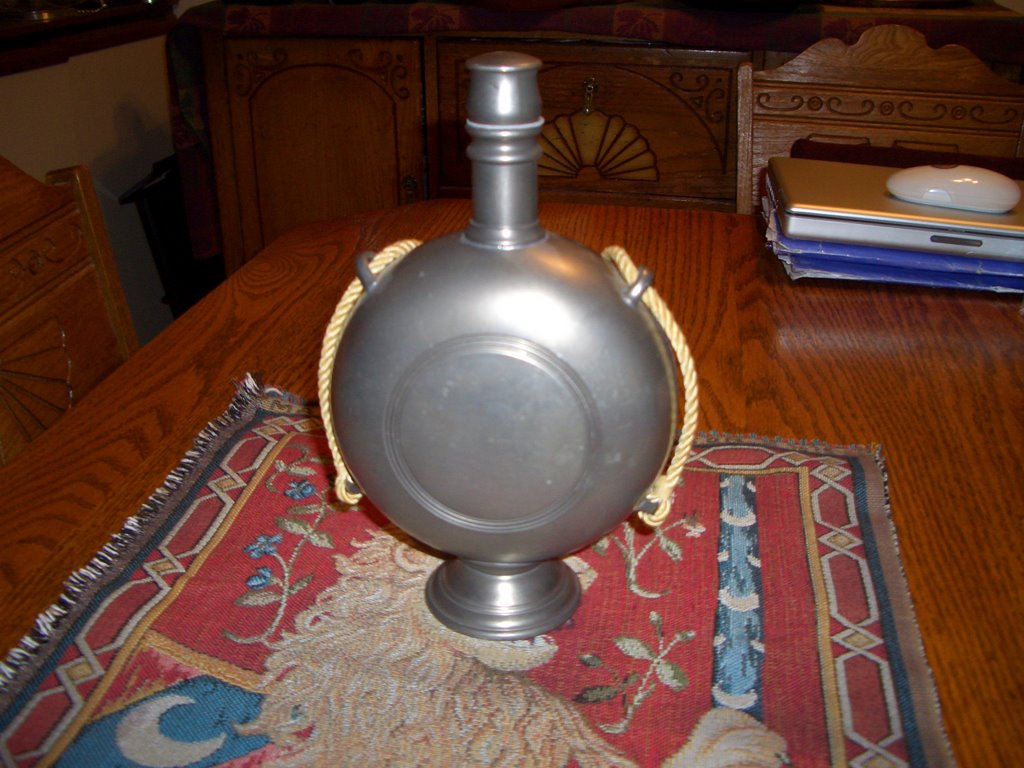
For much of my time in the SCA, I've been especially interested in medieval plate, or table settings. Few pieces of genuinely period design can be obtained, and most people settle for pieces that look old-fashioned or not modern (which is indeed better than nothing). In my quest for authenticity, I am locally famous for using a covered cup that is actually a modern silverplate compote but which strongly resembles covered cups of the period.
I have long desired a pilgrim's flask, which looks like a canteen with an oval foot. They are often featured in paintings of the 14th and 15th centuries, in particular. The pattern is a very old one - much used in the classical Mediterranean, and one sees ceramic and pottery versions down to today. I have seen models used by recreation groups in Europe, but have never been able to discover where they got them. Making one is a bit beyond my meager metal-working skills.
Having searched for years on eBay, I became aware that an old Dutch pewter company, Daalderop Royal Holland, had produced a pilgrim's flask in pewter at some time in the 20th century. The first one I saw was missing the cap, so I didn't bid, but I recently obtained the object of my desire, for a rather substantial price. I haven't used it at a revel or event yet, but I plan to soon.
Saturday, April 01, 2006
Flint Institute of Arts
This afternoon, Melisande and I visited the Flint Institute of Arts, which was recently remodeled. We had been planning to see "To Be, Or Not To Be: Four Hundred Years of Vanitas Painting", an exhibit which ends on April 2. There is almost no medieval content in the exhibit, unfortunately, although some of the painters were born during the Renaissance. Vanitas painting was developed during the 17th Century.
A vanitas painting is a still life (usually) whose imagery suggests imminent decay and mortality. There is often a watch, or fruit about to spoil. In one memorable painting, a mouse is hiding amid the remains of breakfast, unaware of a cat about to pounce. Many of the paintings in the exhibit are very beautiful, some slightly disturbing.
There was a striking difference between the older paintings, before the turn of the 20th century, and the more recent ones. Even for the more representational paintings, the modern paintings were usually crude, blatant or garish. The older paintings were subtle, and usually more skillfully done, although there was amazing skill in some of the more recent paintings, too. The only piece of three-dimensional modern art was spectacularly childish. Melisande looked at it for a moment and then hurried away to the next piece, covering her mouth and trying not to laugh out loud.
I should add that about three of the more modern paintings were quite exceptional, including two I'd love to have prints for - but they were noticeably of the older style, too.
There is a hardcover book on the exhibition for $25, which we bought (that's a very reasonable price for a catalogue of its kind - they usually top $35 and are usually bound in cardstock.) The text is very well-written, and I noticed that the commentary beside the artwork itself had been written with an unusual degree of skill and wit.
An aside about the FIA. I often grow short-tempered with those who denigrate Flint, which admittedly has its problems. Flint can hardly be compared to Ann Arbor or Grand Rapids on this score, but those who think the city is desolate should go down to the cultural center area between the expressway and Mott Community College. The FIA is a state of the art building with a fine museum shop selling things I had not seen in similar shops elsewhere, and a Starbucks coffee shop. Art by local and state artists was on sale, or could be rented for modest fees (the fees are remitted for eventual purchasers). That seemed like a terrific idea to me - rent art for the office or home, change it whenever you like. The prices were reasonable, and there were also prints. I saw a print of downtown Flint that I think I will buy, frame and put outside my office at Baker after our current remodeling settles down.
There is an element of the FIA that is of more interest to the SCA. The Institute has a fine collection of Renaissance (and slightly later) furniture and tapestry, among other things, in the Bray Gallery. We didn't seek it out today, as we had other places to go. I saw it years ago and was quite impressed.
A vanitas painting is a still life (usually) whose imagery suggests imminent decay and mortality. There is often a watch, or fruit about to spoil. In one memorable painting, a mouse is hiding amid the remains of breakfast, unaware of a cat about to pounce. Many of the paintings in the exhibit are very beautiful, some slightly disturbing.
There was a striking difference between the older paintings, before the turn of the 20th century, and the more recent ones. Even for the more representational paintings, the modern paintings were usually crude, blatant or garish. The older paintings were subtle, and usually more skillfully done, although there was amazing skill in some of the more recent paintings, too. The only piece of three-dimensional modern art was spectacularly childish. Melisande looked at it for a moment and then hurried away to the next piece, covering her mouth and trying not to laugh out loud.
I should add that about three of the more modern paintings were quite exceptional, including two I'd love to have prints for - but they were noticeably of the older style, too.
There is a hardcover book on the exhibition for $25, which we bought (that's a very reasonable price for a catalogue of its kind - they usually top $35 and are usually bound in cardstock.) The text is very well-written, and I noticed that the commentary beside the artwork itself had been written with an unusual degree of skill and wit.
An aside about the FIA. I often grow short-tempered with those who denigrate Flint, which admittedly has its problems. Flint can hardly be compared to Ann Arbor or Grand Rapids on this score, but those who think the city is desolate should go down to the cultural center area between the expressway and Mott Community College. The FIA is a state of the art building with a fine museum shop selling things I had not seen in similar shops elsewhere, and a Starbucks coffee shop. Art by local and state artists was on sale, or could be rented for modest fees (the fees are remitted for eventual purchasers). That seemed like a terrific idea to me - rent art for the office or home, change it whenever you like. The prices were reasonable, and there were also prints. I saw a print of downtown Flint that I think I will buy, frame and put outside my office at Baker after our current remodeling settles down.
There is an element of the FIA that is of more interest to the SCA. The Institute has a fine collection of Renaissance (and slightly later) furniture and tapestry, among other things, in the Bray Gallery. We didn't seek it out today, as we had other places to go. I saw it years ago and was quite impressed.
Sunday, March 05, 2006
SCA Podcast
Check out www.painbank.com for Midrealm-centric podcasts. I've listened to part of the first program, and it sounds like fun. Mostly armored combat topics. They refer obliquely to more SCA podcasts, so I'll check them out and report on them.
Saturday, March 04, 2006
Pentamere Fighter's College Report
As noted yesterday, Melisande, Geirmundr and I attended the regional war college event in the Canton of Weald Lake today. We provided breakfast on behalf of Stormvale, and that was well-received.
The event was held at a conference center/retreat sort of place. We were in a lodge that had a largish conference room, a little kitchen, a lounge with a fireplace and a bunch of rooms with bunkbeds, some large enough that private discussions or conferences could be held in them. It was a nice place, although slightly crowded at times. There were 60+ attendees.
In the morning, Sir Jocelyn le Jongleur, the Pentamere Regional Commander and organizer of the event, introduced the program. She also led a brainstorming session on creativity and tactical planning later. Duke Sir Brannos discussed a wide-ranging set of issues around the theme of the "mental game" - he's quite an engaging speaker. He and Sir Tom Tintinabulum then split the attendees into two groups.
I went to polearm tactics with Sir Tom, while Geirmundr attended the spear thing. Not sure I really learned anything new (I learned polearm by having then-Lord Crispin Bucher beat me up for a few months, after which I was, as you would expect, reasonably competent), but it was a nice refresher course. Where Sir Tom's comments did intrigue me was in how to be productive on the battlefield with a polearm. I was never any damn good at that - single combat was my thing. I always wanted sword and shield or a spear for melees. Or two-stick for small melees where it was useful to create chaos as a skirmisher and flanker or intimidator. He also had some pointers on polearm construction and some comments on weapon weight that I thought were useful and interesting.
Sir Dubricius (whom I had never met, although he looks familiar) taught a very interesting class for the whole group on movement. This was really worthwhile. He and colleagues were examining a medieval text on sword and buckler fighting three years ago, he explained, and they realized that applying the movements was hard because the text didn't explain footwork. So they began to try to work up a way of explaining and defining footwork as practiced by the better Midrealm fighters when practicing their "A" game. I can hardly say how useful and productive I think the project is. We got a thorough explanation and demonstration, together with a more general discussion on fighting in an open combat order. That was coming into use when I fought more actively, but I'm glad to see it is now generally accepted.
We broke for lunch, and then we had a class and discussion with Sir Straum, the Midrealm general, who explained the Midrealm army command structure, and answered questions, mostly about the perennial problem of the wandering busybody telling units to do something outside of the chain of command. He had an admirable view on this, I thought. He also had some remarks about fencing and archery that I'll refer to in another post.
Sir Jocelyn taught her class then, and there was a break. Melisande, who had been very patient, and I left at that point. Geirmundr stayed a while longer.
My general comments - I wish we had done this sort of thing back when I was a much more active fighter. It would have been a very good idea. And I enjoyed the opportunity to hear what was going on. Now if I can continue to get back in armor and can actually get to melee events this summer...
More comments of a specific Stormvale nature later.
The event was held at a conference center/retreat sort of place. We were in a lodge that had a largish conference room, a little kitchen, a lounge with a fireplace and a bunch of rooms with bunkbeds, some large enough that private discussions or conferences could be held in them. It was a nice place, although slightly crowded at times. There were 60+ attendees.
In the morning, Sir Jocelyn le Jongleur, the Pentamere Regional Commander and organizer of the event, introduced the program. She also led a brainstorming session on creativity and tactical planning later. Duke Sir Brannos discussed a wide-ranging set of issues around the theme of the "mental game" - he's quite an engaging speaker. He and Sir Tom Tintinabulum then split the attendees into two groups.
I went to polearm tactics with Sir Tom, while Geirmundr attended the spear thing. Not sure I really learned anything new (I learned polearm by having then-Lord Crispin Bucher beat me up for a few months, after which I was, as you would expect, reasonably competent), but it was a nice refresher course. Where Sir Tom's comments did intrigue me was in how to be productive on the battlefield with a polearm. I was never any damn good at that - single combat was my thing. I always wanted sword and shield or a spear for melees. Or two-stick for small melees where it was useful to create chaos as a skirmisher and flanker or intimidator. He also had some pointers on polearm construction and some comments on weapon weight that I thought were useful and interesting.
Sir Dubricius (whom I had never met, although he looks familiar) taught a very interesting class for the whole group on movement. This was really worthwhile. He and colleagues were examining a medieval text on sword and buckler fighting three years ago, he explained, and they realized that applying the movements was hard because the text didn't explain footwork. So they began to try to work up a way of explaining and defining footwork as practiced by the better Midrealm fighters when practicing their "A" game. I can hardly say how useful and productive I think the project is. We got a thorough explanation and demonstration, together with a more general discussion on fighting in an open combat order. That was coming into use when I fought more actively, but I'm glad to see it is now generally accepted.
We broke for lunch, and then we had a class and discussion with Sir Straum, the Midrealm general, who explained the Midrealm army command structure, and answered questions, mostly about the perennial problem of the wandering busybody telling units to do something outside of the chain of command. He had an admirable view on this, I thought. He also had some remarks about fencing and archery that I'll refer to in another post.
Sir Jocelyn taught her class then, and there was a break. Melisande, who had been very patient, and I left at that point. Geirmundr stayed a while longer.
My general comments - I wish we had done this sort of thing back when I was a much more active fighter. It would have been a very good idea. And I enjoyed the opportunity to hear what was going on. Now if I can continue to get back in armor and can actually get to melee events this summer...
More comments of a specific Stormvale nature later.
Friday, March 03, 2006
Pentamere Fighter's College
Stormvale is providing breakfast for the Pentamere Fighter's College in Brighton tomorrow. Melisande and I spent part of the day shopping for suitable doughnuts and the like. We're leaving at 8 am for a 9 am arrival. Looking forward to the classes, too.
Doesn't look like many Stormvale attendees, however. Geirmundr is going, but it looks like flu, work and family obligations and the like are going to prevent much other attendance. I'll report here on what happens, of course.
Donations for the expense of breakfast are invited. Just see Geirmundr, Melisande or me.
Doesn't look like many Stormvale attendees, however. Geirmundr is going, but it looks like flu, work and family obligations and the like are going to prevent much other attendance. I'll report here on what happens, of course.
Donations for the expense of breakfast are invited. Just see Geirmundr, Melisande or me.
Monday, January 16, 2006
A Correction on the Award Post Below
I am informed that court no longer features the hoary old habit of asking "or someone to accept for them". What a very good idea. Instead, a reliable person is asked to see the signet after the event. Now, see, I haven't been to court in a couple of years, which makes me a bad person, as I described below!
(Actually, I'm sure I went to court the last time I went to an event that featured one, but that's been a little while, too.)
At any rate, the essential point is still valid. It should be a mild slip-up if one of our locals isn't in court to get an award, and a somewhat bigger slip-up if a reliable person (an officer or blood relative is best, the regional signet informs us) is not there right after court to claim the scroll and deliver it and the happy news to the recipient.
(Actually, I'm sure I went to court the last time I went to an event that featured one, but that's been a little while, too.)
At any rate, the essential point is still valid. It should be a mild slip-up if one of our locals isn't in court to get an award, and a somewhat bigger slip-up if a reliable person (an officer or blood relative is best, the regional signet informs us) is not there right after court to claim the scroll and deliver it and the happy news to the recipient.
More on Awards
A couple of months ago, I made some remarks on a curious phenomenon regarding awards for local members. We had discovered that several local members received awards during 2005, but at events we had not attended. My reaction is essentially the same as before, but I want to discuss it from a slightly different aspect.
As we've discussed this locally (and made some headway on taking care of the problem), I've become aware that there are still some slight misperceptions about the way the system works. (Since the officer talk seemed helpful, I may try one on awards next month!) In particular, I noticed there is some concern about why no one notified us that the awards had been made. Was there perhaps some failure of communication from kingdom to shire?
The answer to this question is, no, it's actually our fault, and up to us to make sure it doesn't happen again. This will require a little explanation, so please bear with me.
I can recall the same sort of confusion about how it all works in my early years in the SCA (it isn't precisely true that I've forgotten more about the functioning of the SCA than I presently know, but it sometimes seems like it when I exert my memory and reach back into the dim, primeval mists of time...), so I sympathize. Let me put it this way:
The king and queen of the Middle attend an event somewhere between 2-3 times a month. At the majority of such events, they hold court and make awards to deserving local members. That's a lot of awards. Their Majesties are very busy people with all that traveling and everything that goes with it. They take awards very seriously and not only want to recognize their deserving subjects but also not to make a mistake and recognize someone who isn't really deserving. Since the kingdom is big and they can't know everyone, they rely to a considerable degree first on the populace at large to make recommendations, and also on their hard-working staff and their peers, courtiers and kingdom officers to help them make a good decision on some of the nominations.
It is often pointed out that anyone can nominate anyone else for any award. But it should be fairly obvious that the kingdom takes seriously the heirarchy of honors it bestows, and it has a method for making the system work. To take an obvious example, if 40 lords and ladies nominate a person they believe deserving to be knighted, Their Majesties are likely to find that very interesting. But not nearly as interesting as 40 knights telling them the same thing. (To be blunt, in the first instance, the guy gets a little more examination; in the second case, he gets knighted.) This way of looking at things extends down through the whole system. If 8 people from three different groups tell Their Majesties that a hard-working person should be considered for an Award of Arms or a Purple Fret, it is quite likely that the award will be made. In fact, the threshold for making an AoA can fairly be said to be a good deal lower than this. A single convincing nomination from a person the Crown knows or even knows of, or even finds persuasive, might well be enough (depending on the royalty and their preferences, to be sure - it's their show, and I'm just describing what I have observed to be the case, broadly speaking.)
So the kingdom has probably dozens of awards in a typical month, more in some. It can readily be imagined how hard this is to keep track of. The royalty are not responsible for putting these awards in the kingdom Order of Precedence database, it may be interesting to learn. The heralds are the ones who do that, when they make court reports to the Clerk of Precedence.
There is a considerable bureaucracy in even a part-time medieval kingdom, but it is a volunteer bureaucracy. One of the things it is not set up to do is to send, for example, letters to recipients to notify them they have received the award when they were not present in court.
Well, why not, a reasonable person might ask?
Because the award itself, and the scroll presented in court, is the notification. Consider - in our Society, getting any sort of recognition at the hands of Their Majesties is a big deal. Even if you have a lot of awards already, it is a notable event that people have taken time and trouble over, from the nomination to the decision to someone making the scroll. The Middle, one should note, is one of the few kingdoms which still prides itself on giving a hand-lettered and illuminated scroll for every single award from the most glory-dipped knighting to the relatively humble Award of Arms. This is inherently because they are both important to the kingdom and its members. Believe me, the new knight does not feel more joy than the delight of the new armiger.
The thing is, the kingdom operates on the assumption that most of the people who get nominated will show up in that court, partly because it is usually a local event at which most of the local members are assumed to be likely to attend, and because their friends who nominated them are usually quite eager to make sure they are there.
There is another underlying and not much examined assumption - that everyone comes to court whenever they can, so they are probably there when they get an award anyway. This is actually not true anymore, and probably hasn't been since at least the 1980s, but it is a leftover assumption from when the kingdom was small in population (though very large indeed in expanse), and everyone knew everyone else.
But that leaves aside another fact that preserves this system from chaos. Ordinarily, if Lady N from Podunkshire on the other side of the state gets the Order of the Willow at court, and she is, regrettably not in court as expected, several other things happen. For one thing, some at least of her friends and acquaintances are there. Even if her whole shire didn't come, somebody at court knows her, even just a little, and is delighted to accept the award on her behalf when it becomes plain that Lady N. is not going to appear when summoned. And after court, that person phones Lady N., or perhaps sends word with another friend.
(This isn't fanciful. I wasn't present for only one of my awards, a completely surprising second Purple Fret in the mid 90s. My friend Sir Stephen Egremont acccepted it for me and phoned me later to tell me about it, and to tell me how pleased and proud he was to do it. I was a somewhat diffident member of his household at the time, and indeed a retainer of his, but it wouldn't have surprised me if he or someone else outside my own shire had accepted any particular award for me whether I was formally associated with them or not. That's how it works.)
So the real question is, when several awards were made to Stormvale members in recent months, why didn't someone accept for them? Because, again, no one was there from Stormvale to accept, and because no one else knew (or perhaps remembered, in a couple of cases) the name.
Thus, no phone call or letter. We saw the award when it appeared in the Pale later.
Now, it should be fairly plain after my explanation, unless I have been too prolix, this state of affairs is merely unusual. No one has failed to do what is expected, except us in not having more ties with our neighbors. A matter easily enough corrected, and I think we're already working on it.
As we've discussed this locally (and made some headway on taking care of the problem), I've become aware that there are still some slight misperceptions about the way the system works. (Since the officer talk seemed helpful, I may try one on awards next month!) In particular, I noticed there is some concern about why no one notified us that the awards had been made. Was there perhaps some failure of communication from kingdom to shire?
The answer to this question is, no, it's actually our fault, and up to us to make sure it doesn't happen again. This will require a little explanation, so please bear with me.
I can recall the same sort of confusion about how it all works in my early years in the SCA (it isn't precisely true that I've forgotten more about the functioning of the SCA than I presently know, but it sometimes seems like it when I exert my memory and reach back into the dim, primeval mists of time...), so I sympathize. Let me put it this way:
The king and queen of the Middle attend an event somewhere between 2-3 times a month. At the majority of such events, they hold court and make awards to deserving local members. That's a lot of awards. Their Majesties are very busy people with all that traveling and everything that goes with it. They take awards very seriously and not only want to recognize their deserving subjects but also not to make a mistake and recognize someone who isn't really deserving. Since the kingdom is big and they can't know everyone, they rely to a considerable degree first on the populace at large to make recommendations, and also on their hard-working staff and their peers, courtiers and kingdom officers to help them make a good decision on some of the nominations.
It is often pointed out that anyone can nominate anyone else for any award. But it should be fairly obvious that the kingdom takes seriously the heirarchy of honors it bestows, and it has a method for making the system work. To take an obvious example, if 40 lords and ladies nominate a person they believe deserving to be knighted, Their Majesties are likely to find that very interesting. But not nearly as interesting as 40 knights telling them the same thing. (To be blunt, in the first instance, the guy gets a little more examination; in the second case, he gets knighted.) This way of looking at things extends down through the whole system. If 8 people from three different groups tell Their Majesties that a hard-working person should be considered for an Award of Arms or a Purple Fret, it is quite likely that the award will be made. In fact, the threshold for making an AoA can fairly be said to be a good deal lower than this. A single convincing nomination from a person the Crown knows or even knows of, or even finds persuasive, might well be enough (depending on the royalty and their preferences, to be sure - it's their show, and I'm just describing what I have observed to be the case, broadly speaking.)
So the kingdom has probably dozens of awards in a typical month, more in some. It can readily be imagined how hard this is to keep track of. The royalty are not responsible for putting these awards in the kingdom Order of Precedence database, it may be interesting to learn. The heralds are the ones who do that, when they make court reports to the Clerk of Precedence.
There is a considerable bureaucracy in even a part-time medieval kingdom, but it is a volunteer bureaucracy. One of the things it is not set up to do is to send, for example, letters to recipients to notify them they have received the award when they were not present in court.
Well, why not, a reasonable person might ask?
Because the award itself, and the scroll presented in court, is the notification. Consider - in our Society, getting any sort of recognition at the hands of Their Majesties is a big deal. Even if you have a lot of awards already, it is a notable event that people have taken time and trouble over, from the nomination to the decision to someone making the scroll. The Middle, one should note, is one of the few kingdoms which still prides itself on giving a hand-lettered and illuminated scroll for every single award from the most glory-dipped knighting to the relatively humble Award of Arms. This is inherently because they are both important to the kingdom and its members. Believe me, the new knight does not feel more joy than the delight of the new armiger.
The thing is, the kingdom operates on the assumption that most of the people who get nominated will show up in that court, partly because it is usually a local event at which most of the local members are assumed to be likely to attend, and because their friends who nominated them are usually quite eager to make sure they are there.
There is another underlying and not much examined assumption - that everyone comes to court whenever they can, so they are probably there when they get an award anyway. This is actually not true anymore, and probably hasn't been since at least the 1980s, but it is a leftover assumption from when the kingdom was small in population (though very large indeed in expanse), and everyone knew everyone else.
But that leaves aside another fact that preserves this system from chaos. Ordinarily, if Lady N from Podunkshire on the other side of the state gets the Order of the Willow at court, and she is, regrettably not in court as expected, several other things happen. For one thing, some at least of her friends and acquaintances are there. Even if her whole shire didn't come, somebody at court knows her, even just a little, and is delighted to accept the award on her behalf when it becomes plain that Lady N. is not going to appear when summoned. And after court, that person phones Lady N., or perhaps sends word with another friend.
(This isn't fanciful. I wasn't present for only one of my awards, a completely surprising second Purple Fret in the mid 90s. My friend Sir Stephen Egremont acccepted it for me and phoned me later to tell me about it, and to tell me how pleased and proud he was to do it. I was a somewhat diffident member of his household at the time, and indeed a retainer of his, but it wouldn't have surprised me if he or someone else outside my own shire had accepted any particular award for me whether I was formally associated with them or not. That's how it works.)
So the real question is, when several awards were made to Stormvale members in recent months, why didn't someone accept for them? Because, again, no one was there from Stormvale to accept, and because no one else knew (or perhaps remembered, in a couple of cases) the name.
Thus, no phone call or letter. We saw the award when it appeared in the Pale later.
Now, it should be fairly plain after my explanation, unless I have been too prolix, this state of affairs is merely unusual. No one has failed to do what is expected, except us in not having more ties with our neighbors. A matter easily enough corrected, and I think we're already working on it.
January Revel
After the disappointment of not being able to get to 12th Night in Northwoods last weekend, it was fun to have such a nice revel today. We had a great turnout, up near the top numbers we've had in recent years, with 24 during the day and 22 dining.
In keeping with our current practice, we had our Shire Council during the meal. Still seems strange to me, but it appears to be a pretty good idea. I noticed some of our members were a trifle bored by the half-hour meeting, but most people didn't seem to mind the captive audience idea. We got some decisions made, at any right. This is a concept that was adopted during my absence in the summer, and I'm content to continue to try it. Certainly the dedicated business meetings on a weeknight once a month weren't working all that well.
Before the meeting, I convened an officer's meeting to get everyone caught up with their duties, since we had had a good deal of turnover. We used a PowerPoint presentation I compiled yesterday to guide the discussion, and it seemed to work pretty well. After I tweak it, we'll put it up at Stormvale's website. Which makes me think that other presentations might be useful: how to put on an event, for example, or more detailed presentations for how to get started with a particular office. Or a run-through on how to get started in armored combat.
I've noticed something in recent years - January is always an unusually well-attended revel. I wonder if it's because the holidays are over and people are ready to get back at the SCA? If it's going to be a reasonably big deal, perhaps we should call it our 12th Night. Actually, I'd like to make each month's revel a little special, with a name or title.
In keeping with our current practice, we had our Shire Council during the meal. Still seems strange to me, but it appears to be a pretty good idea. I noticed some of our members were a trifle bored by the half-hour meeting, but most people didn't seem to mind the captive audience idea. We got some decisions made, at any right. This is a concept that was adopted during my absence in the summer, and I'm content to continue to try it. Certainly the dedicated business meetings on a weeknight once a month weren't working all that well.
Before the meeting, I convened an officer's meeting to get everyone caught up with their duties, since we had had a good deal of turnover. We used a PowerPoint presentation I compiled yesterday to guide the discussion, and it seemed to work pretty well. After I tweak it, we'll put it up at Stormvale's website. Which makes me think that other presentations might be useful: how to put on an event, for example, or more detailed presentations for how to get started with a particular office. Or a run-through on how to get started in armored combat.
I've noticed something in recent years - January is always an unusually well-attended revel. I wonder if it's because the holidays are over and people are ready to get back at the SCA? If it's going to be a reasonably big deal, perhaps we should call it our 12th Night. Actually, I'd like to make each month's revel a little special, with a name or title.
Tuesday, January 10, 2006
Progress of a Student of Arms II
Wow, long time between posts. Sorry about that, got busy with work.
A week after Founder's Day, referred to in the Nov. 13 post below, I went to the Iron Oak Toys for Tots event. First time I'd gone to a tournament in a long time, and I was looking forward to it.
It was a beautiful day, very sunny and pleasant, and there was a small field of combatants. I donned about half my armor and had moved much of my gear near the list field when I had an unexpected problem. I wear contact lenses to fight, and that is nearly the only time I trouble with the things anymore. In addition to the hassle, I now use bifocal lenses in my glasses, so contacts also require keeping reading glasses handy.
(Aside - try teaching a college class in contacts and have to resort to reading glasses when you want to look at the book. Your students snicker at you. Whippersnappers.)
Anyway, I was putting in the contacts next to the car, done it a million times before a practice or tournament, and there was a gust of wind and one of the contacts blew off my finger and disappeared. First time that had ever happened.
Now, I once forgot my contacts when I went to a practice, many, many years ago, and got my rear end kicked and didn't much enjoy it. So I was reluctant, but even more reluctant to not fight after putting half my armor on.
So I fought. It didn't go badly - I even won a bout or two. Disconcerting, and I felt as though I could have done much better. You know, if I could see what I was doing.
Next time, I'll try bringing extra contacts! Now, if I could just talk Geirmundr and Erevon into wearing contacts or sports glasses when they fight...
A week after Founder's Day, referred to in the Nov. 13 post below, I went to the Iron Oak Toys for Tots event. First time I'd gone to a tournament in a long time, and I was looking forward to it.
It was a beautiful day, very sunny and pleasant, and there was a small field of combatants. I donned about half my armor and had moved much of my gear near the list field when I had an unexpected problem. I wear contact lenses to fight, and that is nearly the only time I trouble with the things anymore. In addition to the hassle, I now use bifocal lenses in my glasses, so contacts also require keeping reading glasses handy.
(Aside - try teaching a college class in contacts and have to resort to reading glasses when you want to look at the book. Your students snicker at you. Whippersnappers.)
Anyway, I was putting in the contacts next to the car, done it a million times before a practice or tournament, and there was a gust of wind and one of the contacts blew off my finger and disappeared. First time that had ever happened.
Now, I once forgot my contacts when I went to a practice, many, many years ago, and got my rear end kicked and didn't much enjoy it. So I was reluctant, but even more reluctant to not fight after putting half my armor on.
So I fought. It didn't go badly - I even won a bout or two. Disconcerting, and I felt as though I could have done much better. You know, if I could see what I was doing.
Next time, I'll try bringing extra contacts! Now, if I could just talk Geirmundr and Erevon into wearing contacts or sports glasses when they fight...
Sunday, November 13, 2005
Progress of a Student of Arms I
I first donned armor, which I made myself, in 1984. My authorization bout was fought with Sir Andrew Greencloak at the Squire's Revolt, in front of a huge crowd and under the eyes of King Eliahu. I was too green to be nervous, and took Sir Andrew's legs twice, and then won my first tournament combat.
Somehow I never became a squire. Too many lapses while attending law school, or doing heraldry, or after injuries, probably. I got a couple of nibbles from knights, and plenty of advice and kind words from them.
I had a real problem back in the 1980s getting people to take blows. Many times, I was complimented but informed that I was hitting too lightly. The solution was direct: I adopted swords of unusual length and weight, sacrificing a little speed for power. The first time I tried them is on videotape, and there are gratifying exclamations audible in the background. After that I was in the first rank of Stormvale fighters - not the best, but one of the three who delighted in fighting our best, Wilhelm von Buch, later knighted in Ansteorra, rather than dreading it as most did. I could hold my own with anyone locally, and didn't do badly outside.
Our local measurement of excellence is the Stormvale Champion tournament at Founder's Day each fall. I will not conceal that it frustrated me deeply that I could not manage to win this distinction back when we had a dozen entrants in this tournament in the late 80s and early 90s. On one occasion I won it in the lists, but lost it in the other portions of the contest, which included poetry, not my metier. In 1995, after the sudden shrinking of the fighter pool in Stormvale, Erevon FitzGerald and I simply agreed to be co-champions, because we were the only participants, and then we kept it for two years when there was no tourney in 1996. Finally, I won it uncontestably in the lists in 2000, to my very great satisfaction, defeating Lord Torashi, who was easily as worthy of the honor as I.
Which is all a long way of getting around to mentioning that I won it again on November 6 at Founders Day 17. There were plenty of fencers and archers, but again only Erevon and I to fight - we think the weather held down attendance. This time, however, we fought it out. We just fought until the light quit, keeping track of individual wins. I took an early lead of 8-4 and then tired, and we were tied at 9-9. We were both tired and the light was failing rapidly, so I suggested that we simply fight one more and the winner would be the champion.
Afterwards, I realized that it might have been fairer to Erevon to make it best 2 of 3. One of my meager talents as a fighter is that when very tired, I can dig deep for energy and put forth a maximum effort for one more bout. Erevon's great strength is his steadiness and persistence. For that last fight, I came out bouncy and aggressive, head clear, blows hard and crisp. Erevon stopped a flat snap to the left side of his head so close to the helm that his own sword banged it so hard he thought about taking the blow. He didn't, rightly, and I wouldn't have let him. No one should win the Stormvale Championship cheaply. A moment later, that same flat snap got him while he was hitting my right side with his own blow... but about one second after mine.
There were only two of us, admittedly, but I think we did honor to our shire. Like characters in the Morte d'Arthur, we fought to exhaustion, then went and had a drink (coffee, in our case) and told everyone else stories about how the other fought the rest of the evening.
Well, that's what I joined the SCA for.
Somehow I never became a squire. Too many lapses while attending law school, or doing heraldry, or after injuries, probably. I got a couple of nibbles from knights, and plenty of advice and kind words from them.
I had a real problem back in the 1980s getting people to take blows. Many times, I was complimented but informed that I was hitting too lightly. The solution was direct: I adopted swords of unusual length and weight, sacrificing a little speed for power. The first time I tried them is on videotape, and there are gratifying exclamations audible in the background. After that I was in the first rank of Stormvale fighters - not the best, but one of the three who delighted in fighting our best, Wilhelm von Buch, later knighted in Ansteorra, rather than dreading it as most did. I could hold my own with anyone locally, and didn't do badly outside.
Our local measurement of excellence is the Stormvale Champion tournament at Founder's Day each fall. I will not conceal that it frustrated me deeply that I could not manage to win this distinction back when we had a dozen entrants in this tournament in the late 80s and early 90s. On one occasion I won it in the lists, but lost it in the other portions of the contest, which included poetry, not my metier. In 1995, after the sudden shrinking of the fighter pool in Stormvale, Erevon FitzGerald and I simply agreed to be co-champions, because we were the only participants, and then we kept it for two years when there was no tourney in 1996. Finally, I won it uncontestably in the lists in 2000, to my very great satisfaction, defeating Lord Torashi, who was easily as worthy of the honor as I.
Which is all a long way of getting around to mentioning that I won it again on November 6 at Founders Day 17. There were plenty of fencers and archers, but again only Erevon and I to fight - we think the weather held down attendance. This time, however, we fought it out. We just fought until the light quit, keeping track of individual wins. I took an early lead of 8-4 and then tired, and we were tied at 9-9. We were both tired and the light was failing rapidly, so I suggested that we simply fight one more and the winner would be the champion.
Afterwards, I realized that it might have been fairer to Erevon to make it best 2 of 3. One of my meager talents as a fighter is that when very tired, I can dig deep for energy and put forth a maximum effort for one more bout. Erevon's great strength is his steadiness and persistence. For that last fight, I came out bouncy and aggressive, head clear, blows hard and crisp. Erevon stopped a flat snap to the left side of his head so close to the helm that his own sword banged it so hard he thought about taking the blow. He didn't, rightly, and I wouldn't have let him. No one should win the Stormvale Championship cheaply. A moment later, that same flat snap got him while he was hitting my right side with his own blow... but about one second after mine.
There were only two of us, admittedly, but I think we did honor to our shire. Like characters in the Morte d'Arthur, we fought to exhaustion, then went and had a drink (coffee, in our case) and told everyone else stories about how the other fought the rest of the evening.
Well, that's what I joined the SCA for.
Wednesday, November 09, 2005
Award Nomination Tactics
We got some belated good news in Stormvale today, but it was also a little perplexing.
At the Havoc in Hastings event on September 3 in Andelcrag, three of our members received awards: an Award of Arms for Stormvale Web Minister Mariska of Stormvale; an Award of the Purple Fret for co-host of the populace meetings Giovanna Costanza; and an Order of the Silver Oak to period fishing scholar Breac MacFinnein.
At the Squires Revolt event on October 8 in Northwoods, two members received awards: a second Award of the Purple Fret for co-host of the populace meetings Skalla Geirmundr Ulfsson; and a re-award of the Silver Oak to Breac.
One thing in common for these two Pentamere events? Apparently, not only were none of the awardees present, no one from Stormvale was present to report back or accept for them. We only found out about them, and now we're not sure we know about all such occasions, when I happened to glance at a Court Report in the November Pale today.
This leads to some thoughts about award nominations. Most of us are aware that there have been a number of very hard working members locally who we ought to promote to the Crown as deserving of awards, mostly service or arts and sciences awards. Obviously, some of us are making those nominations and some of them are getting made. That's the good news.
The bad news is that it looks odd to those in court and around the region when there is never anyone in court to accept these awards from our group. This sort of thing tends to annoy the Crown, too. First we ask them for an award for someone from our group, then no one from our group bothers to attend their court to either receive or note their largesse.
We need to promote our deserving members in hopes of their recognition. But we also need to make sure our members attend local courts at which they may receive awards. This is a delicate business, because the prospective recipient cannot be told they may receive an award. So how to get them there?
One tactic is to tell such persons that they may want to attend a particular court to observe a friend getting an award. Since nominations tend to come in clumps and several members often know about the nominations, this is plausible a argument and tactic. After all, we should be there to cheer on our colleagues anyway.
A better tactic is to simply plan as individuals and groups of friends to attend more local events, and to stay for court. Often, nothing will happen of personal interest to us, but courts are interesting in and of themselves. One meets people and finds out what is going on in the kingdom and in our region. One sees how to behave when called for an award, so one knows how to behave oneself.
A final word: this a two-part thing. Nominating people is good. Getting them there to accept is also necessary whenever possible.
At the Havoc in Hastings event on September 3 in Andelcrag, three of our members received awards: an Award of Arms for Stormvale Web Minister Mariska of Stormvale; an Award of the Purple Fret for co-host of the populace meetings Giovanna Costanza; and an Order of the Silver Oak to period fishing scholar Breac MacFinnein.
At the Squires Revolt event on October 8 in Northwoods, two members received awards: a second Award of the Purple Fret for co-host of the populace meetings Skalla Geirmundr Ulfsson; and a re-award of the Silver Oak to Breac.
One thing in common for these two Pentamere events? Apparently, not only were none of the awardees present, no one from Stormvale was present to report back or accept for them. We only found out about them, and now we're not sure we know about all such occasions, when I happened to glance at a Court Report in the November Pale today.
This leads to some thoughts about award nominations. Most of us are aware that there have been a number of very hard working members locally who we ought to promote to the Crown as deserving of awards, mostly service or arts and sciences awards. Obviously, some of us are making those nominations and some of them are getting made. That's the good news.
The bad news is that it looks odd to those in court and around the region when there is never anyone in court to accept these awards from our group. This sort of thing tends to annoy the Crown, too. First we ask them for an award for someone from our group, then no one from our group bothers to attend their court to either receive or note their largesse.
We need to promote our deserving members in hopes of their recognition. But we also need to make sure our members attend local courts at which they may receive awards. This is a delicate business, because the prospective recipient cannot be told they may receive an award. So how to get them there?
One tactic is to tell such persons that they may want to attend a particular court to observe a friend getting an award. Since nominations tend to come in clumps and several members often know about the nominations, this is plausible a argument and tactic. After all, we should be there to cheer on our colleagues anyway.
A better tactic is to simply plan as individuals and groups of friends to attend more local events, and to stay for court. Often, nothing will happen of personal interest to us, but courts are interesting in and of themselves. One meets people and finds out what is going on in the kingdom and in our region. One sees how to behave when called for an award, so one knows how to behave oneself.
A final word: this a two-part thing. Nominating people is good. Getting them there to accept is also necessary whenever possible.
Saturday, November 05, 2005
Founders Day 17
In October 1982, several of us founded the Shire of Stormvale. From 1988 on, we held an annual local event, Founders Day, to celebrate the anniversary of the group.
The first one had a specific element of congratulation for Lord Garth Brandon and myself. We were given special favors in recognition of our having initiated the branch. In subsequent years, the mini-event became more of a shire birthday party.
The traditional activities grew and changed over the years. The principal features:
* An armored combat tournament to select the Stormvale Champion.
* Later, more tournaments for all the martial arts and for arts and sciences.
* A more elaborate than usual potluck feast, with most attendees wearing some of their finest garb.
* The remaining founders are seated at the head table, if any, with winners of the tournament or other persons the founders wish to honor. (Sometimes if there is no head table arrangement, we don't bother about this, but we do honor the winners of the tournaments and contests during the feast.)
* The definition of founders has expanded a bit over the years, with me, Skalla-Geirmundr and Breac MacFinnein being the principal earliest members of the shire still active.
* There are pomegranates, Stormvale's special symbol of renewal and rebirth, at the feast.
At Stormvale's 20th Year Anniversary, Founder's Day was subsumed into the larger event. We have usually held it at a member's home, but sometimes at larger venues like churches or apartment clubhouses. Last year's was rather large, and if this year is similar, we may want to consider moving to a larger type of site again.
Thanks to Lord Gerard von Lowenstein for hosting Founder's Day two years in a row!
There will probably be two "founders" there tomorrow - Breac and I. Geirmundr is out of town this weekend and wasn't sure he would be back in time. Hopefully, most of the Champions will be there to defend their titles:
Armored Combat: Lord Tsunami Zentaro Tadahiro
Rapier Combat and Archery: Lord Joseff of Loc Sproule
Arts and Sciences: Connor McGrath
The fun starts at 1 pm. See the Stormvale website or the recent This Week in Stormvale post on the announcements list for more details.
The first one had a specific element of congratulation for Lord Garth Brandon and myself. We were given special favors in recognition of our having initiated the branch. In subsequent years, the mini-event became more of a shire birthday party.
The traditional activities grew and changed over the years. The principal features:
* An armored combat tournament to select the Stormvale Champion.
* Later, more tournaments for all the martial arts and for arts and sciences.
* A more elaborate than usual potluck feast, with most attendees wearing some of their finest garb.
* The remaining founders are seated at the head table, if any, with winners of the tournament or other persons the founders wish to honor. (Sometimes if there is no head table arrangement, we don't bother about this, but we do honor the winners of the tournaments and contests during the feast.)
* The definition of founders has expanded a bit over the years, with me, Skalla-Geirmundr and Breac MacFinnein being the principal earliest members of the shire still active.
* There are pomegranates, Stormvale's special symbol of renewal and rebirth, at the feast.
At Stormvale's 20th Year Anniversary, Founder's Day was subsumed into the larger event. We have usually held it at a member's home, but sometimes at larger venues like churches or apartment clubhouses. Last year's was rather large, and if this year is similar, we may want to consider moving to a larger type of site again.
Thanks to Lord Gerard von Lowenstein for hosting Founder's Day two years in a row!
There will probably be two "founders" there tomorrow - Breac and I. Geirmundr is out of town this weekend and wasn't sure he would be back in time. Hopefully, most of the Champions will be there to defend their titles:
Armored Combat: Lord Tsunami Zentaro Tadahiro
Rapier Combat and Archery: Lord Joseff of Loc Sproule
Arts and Sciences: Connor McGrath
The fun starts at 1 pm. See the Stormvale website or the recent This Week in Stormvale post on the announcements list for more details.
Wednesday, October 26, 2005
More Book Talk
For readers in the Flint area, check out the Flint Public Library Book Sale this week, which has three more days to run, Thursday 6-8:30 pm, Friday 11 am-3 pm and Saturday 10 am-5 pm. Prices go down on Friday and Saturday. A huge sale with lots of good stuff, both library discards and donations.
(Yes, I already got the best stuff. But I might have missed something. It's conceivable - I 'm feeling under the weather, so my infamous book-finding sense may have flickered once or twice.)
As Melisande was discussing on her blog, Citadel of Stars (listed in the links to the left), we spent the weekend in Traverse City. She described all the wonderful food, so I'll mention the books. I bought a nice history - Richard II and the Revolution of 1399 by Michael Bennett on sale - the sort of thing one couldn't quite afford if not on sale. (Horizon Books on Front Street has a huge and very sophisticated sale section in the basement.)
But my real find was a huge oversized volume from Taschen, the bargain art book people, Masterpieces of Illumination by Ingo F. Walther and Norbert Wolf. The volume surveys, describes and selects beautifully reproduced miniatures or full-page photos from major illuminated manuscripts from 400 to 1600.
I saw it when I was rather tired the night we got there and it didn't really register at first, then I said to myself "Hey, dummy! You collect books on illumination, right? Check that puppy out!" Yeah, I talk to myself like that, baby. Not out loud. Might scare people.
The volume was shrink-wrapped, immaculate, and on sale for $25, allegedly down from $200. I don't know whether it was the last copy or whether $200 was perhaps a reference to the brand-new price in 2001. Probably the latter - this volume was reprinted in 2005. But it was of a size to suggest that it probably was that sort of genuine bargain, and I trust Taschen - I was certain the book was filled with high-quality reproductions on glossy paper.
When I got it back to the hotel room, I was not disappointed. It was a 25 year anniversary production for Taschen and it is gorgeous. Even the binding was of high quality, something that should worry someone buying a modern book at either $200 or $25. For an illumination nut, it would certainly be worth $200. Not to me, perhaps, but only because I can't afford to go around paying $200 for individual books. I'm presently balking at $150 for a volume on medieval bookbinding that I actually need. I'll do it sooner or later, but the illumination book is just a luxury, since I don't illuminate scrolls anymore. Bookbinding is something I want to get into, however.
Well, enough book rambling. Back to grading papers.
(Yes, I already got the best stuff. But I might have missed something. It's conceivable - I 'm feeling under the weather, so my infamous book-finding sense may have flickered once or twice.)
As Melisande was discussing on her blog, Citadel of Stars (listed in the links to the left), we spent the weekend in Traverse City. She described all the wonderful food, so I'll mention the books. I bought a nice history - Richard II and the Revolution of 1399 by Michael Bennett on sale - the sort of thing one couldn't quite afford if not on sale. (Horizon Books on Front Street has a huge and very sophisticated sale section in the basement.)
But my real find was a huge oversized volume from Taschen, the bargain art book people, Masterpieces of Illumination by Ingo F. Walther and Norbert Wolf. The volume surveys, describes and selects beautifully reproduced miniatures or full-page photos from major illuminated manuscripts from 400 to 1600.
I saw it when I was rather tired the night we got there and it didn't really register at first, then I said to myself "Hey, dummy! You collect books on illumination, right? Check that puppy out!" Yeah, I talk to myself like that, baby. Not out loud. Might scare people.
The volume was shrink-wrapped, immaculate, and on sale for $25, allegedly down from $200. I don't know whether it was the last copy or whether $200 was perhaps a reference to the brand-new price in 2001. Probably the latter - this volume was reprinted in 2005. But it was of a size to suggest that it probably was that sort of genuine bargain, and I trust Taschen - I was certain the book was filled with high-quality reproductions on glossy paper.
When I got it back to the hotel room, I was not disappointed. It was a 25 year anniversary production for Taschen and it is gorgeous. Even the binding was of high quality, something that should worry someone buying a modern book at either $200 or $25. For an illumination nut, it would certainly be worth $200. Not to me, perhaps, but only because I can't afford to go around paying $200 for individual books. I'm presently balking at $150 for a volume on medieval bookbinding that I actually need. I'll do it sooner or later, but the illumination book is just a luxury, since I don't illuminate scrolls anymore. Bookbinding is something I want to get into, however.
Well, enough book rambling. Back to grading papers.
Tuesday, October 25, 2005
Crispin's Day
October 25 is St. Crispin's Day, the anniversary of the great victory of Agincourt, at which an outnumbered English army led in person by King Henry V defeated a much larger French army.
What better time for a comparative movie review?!
My friends are groaning as they read this, because I'm getting on a hobby horse of mine, but here goes.
Kenneth Branagh's 1990s version of Henry V is very popular in SCA circles. Branagh has made a number of Shakespeare plays, and some are very good. His Hamlet is generally excellent, for example. I also find Branagh to be a good actor in general. I like him in Dead Again and as the superlatively evil Nazi convening the discussion of the Final Solution at the Wannsee Conference in the recent HBO production.
However, I do not like this version of Henry V. The film has some virtues - the costumes are pretty good, and the youth of Henry's court is interesting - probably very like the reality. But Branagh's acting is wooden, which is unlike him. He shouts a lot - that's all he can do with the great Crispin's Day speech, for example. Also, the armor is poorly done and looks like there was a limited budget. Essex walks around in the kind of plate all the leaders and knights were likely wearing, but Henry himself and everyone else wears what appears to be a coat of plates. I don't think so. The battle scene at Agincourt is awful, the worst sort of Hollywood dreck. Everyone takes their helmets off, and then they wrestle around in the mud. Some sort of anti-war statement, no doubt.
But, gentle reader, you're in luck, because there is a much better option if you want a filmed version of Henry V!
In 1944, Laurence Olivier made a film version of Henry V, largely as a patriotic effort during World War II. This version, which is available on DVD from the Criterion Collection in a beautiful edition, is justly famed as one of the most innovative and remarkable films of all time.
The film starts out as a stage play in the Globe Theatre in London in Elizabethan times, with wonderful little bits of business in every scene. Olivier is shockingly good in this, playing an actor playing the role he's playing once the movie really gets going. The scene with the tennis balls is incredible. Olivier smiles and everyone laughs. He keeps the smile and suddenly the laughter dies away uneasily. I'd like to see Branagh pull that scene off.
Later, as the fleet is about to sail, Chorus introduces the wildest gimmick I've ever seen in a film: as he tells the audience to imagine the vasty fields of France, he also supplies a suitable backdrop for the imagination. The film goes to period costumes for the early 15th century for the rest of the story, but it doesn't become an ordinary period piece. Oh, no. The backdrops are still beautifully stagy, all taken from miniatures in period manuscripts.
The battle scenes are splendid - superb armor all around, everyone keeps their helmets on like sensible people and are instead identified by heraldry (what a concept!) Admittedly, the Frenchmen are winched into their saddles before the battle, but the producers are just making a point - the English leap into the saddle for contrast. (For the uninitiated, nobody was ever winched into the saddle of a horse before a battle - armor wasn't that heavy.) When the English archers let fly, the effect is incredible - a cloud of death blackens the sky.
But best of all is Olivier. When he gives the Crispin's Day speech that Branagh merely shouts, he expresses the full range that made him the greatest actor of his generation. He talks to the soldiers around him, argues with them, flatters them, encourages them. He's not just declaiming the legendary speech, he's making it his own. When he gives it, you want to get up and go with him to fight the French.
The costumes, both the stage 16th century stuff and the medieval outfits, are stunning and inspiring. There really isn't anything to complain about in this movie. Even the bit players have magnificent scenes. The elderly Charles VI is delightfully mad, which heightens the effect when he achieves lucidity for just a moment during the chilling "Of that black name, Edward, Black Prince of Wales" scene, where his dread for his kin and country stand in sharp contrast to the gleaming confidence of the mighty Henry. The actors playing his son and brothers are deliciously dismissive of the old man.
There is nothing like this in the Branagh version. It is just a modern movie, with all the faults of Hollywood and none of the virtues. I recommend the Olivier version emphatically.
(And lest I be thought biased about the actors or the times, I would entirely reverse my recommendation about Hamlet. Olivier's version I find tedious, Branagh's quite good, except for the soliloquys, which Branagh just seems to have trouble with.)
What better time for a comparative movie review?!
My friends are groaning as they read this, because I'm getting on a hobby horse of mine, but here goes.
Kenneth Branagh's 1990s version of Henry V is very popular in SCA circles. Branagh has made a number of Shakespeare plays, and some are very good. His Hamlet is generally excellent, for example. I also find Branagh to be a good actor in general. I like him in Dead Again and as the superlatively evil Nazi convening the discussion of the Final Solution at the Wannsee Conference in the recent HBO production.
However, I do not like this version of Henry V. The film has some virtues - the costumes are pretty good, and the youth of Henry's court is interesting - probably very like the reality. But Branagh's acting is wooden, which is unlike him. He shouts a lot - that's all he can do with the great Crispin's Day speech, for example. Also, the armor is poorly done and looks like there was a limited budget. Essex walks around in the kind of plate all the leaders and knights were likely wearing, but Henry himself and everyone else wears what appears to be a coat of plates. I don't think so. The battle scene at Agincourt is awful, the worst sort of Hollywood dreck. Everyone takes their helmets off, and then they wrestle around in the mud. Some sort of anti-war statement, no doubt.
But, gentle reader, you're in luck, because there is a much better option if you want a filmed version of Henry V!
In 1944, Laurence Olivier made a film version of Henry V, largely as a patriotic effort during World War II. This version, which is available on DVD from the Criterion Collection in a beautiful edition, is justly famed as one of the most innovative and remarkable films of all time.
The film starts out as a stage play in the Globe Theatre in London in Elizabethan times, with wonderful little bits of business in every scene. Olivier is shockingly good in this, playing an actor playing the role he's playing once the movie really gets going. The scene with the tennis balls is incredible. Olivier smiles and everyone laughs. He keeps the smile and suddenly the laughter dies away uneasily. I'd like to see Branagh pull that scene off.
Later, as the fleet is about to sail, Chorus introduces the wildest gimmick I've ever seen in a film: as he tells the audience to imagine the vasty fields of France, he also supplies a suitable backdrop for the imagination. The film goes to period costumes for the early 15th century for the rest of the story, but it doesn't become an ordinary period piece. Oh, no. The backdrops are still beautifully stagy, all taken from miniatures in period manuscripts.
The battle scenes are splendid - superb armor all around, everyone keeps their helmets on like sensible people and are instead identified by heraldry (what a concept!) Admittedly, the Frenchmen are winched into their saddles before the battle, but the producers are just making a point - the English leap into the saddle for contrast. (For the uninitiated, nobody was ever winched into the saddle of a horse before a battle - armor wasn't that heavy.) When the English archers let fly, the effect is incredible - a cloud of death blackens the sky.
But best of all is Olivier. When he gives the Crispin's Day speech that Branagh merely shouts, he expresses the full range that made him the greatest actor of his generation. He talks to the soldiers around him, argues with them, flatters them, encourages them. He's not just declaiming the legendary speech, he's making it his own. When he gives it, you want to get up and go with him to fight the French.
The costumes, both the stage 16th century stuff and the medieval outfits, are stunning and inspiring. There really isn't anything to complain about in this movie. Even the bit players have magnificent scenes. The elderly Charles VI is delightfully mad, which heightens the effect when he achieves lucidity for just a moment during the chilling "Of that black name, Edward, Black Prince of Wales" scene, where his dread for his kin and country stand in sharp contrast to the gleaming confidence of the mighty Henry. The actors playing his son and brothers are deliciously dismissive of the old man.
There is nothing like this in the Branagh version. It is just a modern movie, with all the faults of Hollywood and none of the virtues. I recommend the Olivier version emphatically.
(And lest I be thought biased about the actors or the times, I would entirely reverse my recommendation about Hamlet. Olivier's version I find tedious, Branagh's quite good, except for the soliloquys, which Branagh just seems to have trouble with.)
Saturday, October 22, 2005
Remote Blogging
Ha! I am blogging from the Shire of Donnershafen (Traverse City)! Isn't technology wonderful?
We dropped in on Crown earlier today. Count Felix the Just won.
We dropped in on Crown earlier today. Count Felix the Just won.
Wednesday, October 19, 2005
Shrinking Scope for Nomenclature
A curious phenomenon over the years has changed to some degree the freedom with which participants in the Middle Kingdom can identify their self-chosen roles without reference to a kingdom award of some kind or a relationship with senior armored combatants. I'm not saying it's a bad thing, exactly, just an interesting thing.
The terms I have in mind are sergeant, captain, company and man-at-arms.
When I joined the SCA in 1982, none of these were official designators. That is, they didn't describe roles that the kingdom as an official body took an interest in, nor was there any custom associated with them.
Sergeant was understood at the time to designate any sort of sub-commander in the melee field. The leader of a group of fighters might choose to call himself a captain, or be referred to as such. A company was little-used at the time, but over the years came to refer to a group of any kind, but usually an armored combat unit that modelled itself on late medieval lines. Man-at-arms was used in the period sense: any armored combatant who wore full harness of the sort that knights of his period wore was by definition a man-at-arms, even if he was in fact a knight or a squire.
Of course, no one went around calling themself Sergeant Blank, but it was useful to be able to say "that's Lord Blank. He makes a good sergeant." It was easy to designate the leader of your unit (perhaps a company) as a captain, and sometimes even call them Captain Blank. And if one wasn't a knight or squire, man-at-arms was a good, dignified description that was more satisfying than "fighter."
This began to change in the early 1990s when the kingdom introduced the Order of the Red Company and chose to designate the members as Sergeants. Naturally, the very people one thought of as sergeants in melee combat were the first to be put in this order, but it removed the descriptor as a general term. If one wasn't a member of the Red Company, it was no longer convenient to say "I'm usually a sergeant." This was probably the easiest of these changes to swallow, because in the Middle Ages, there really were Sergeants-at-Arms who were officials of the crown.
Later, the kingdom added the Order of the Gold Mace (ironically, sergeants traditionally bore maces), and these were sergeants who were promoted out of the Red Company Order to be Captains. This effectively made these two orders, together with the chivalry, the official officer structure of the Middle Kingdom's army. It was clever, but it took away another private means of describing roles. You can't readily call yourself "Captain Blank", without having people perhaps assume that you are claiming to be a member of a kingdom order.
Obviously, both these orders and the not-yet-mentioned Order of the Greenwood Company have made calling one's melee unit a company a slightly more sensitive matter. It's still ok to do this, and less problematic than using the terms sergeant or captain, but one may occasionally have to explain to some people that no, you're not calling your group an order, you're just using a period descriptor.
Finally, a recent innovation, and this is more custom than an official change, is to use the term man-at-arms not generally to designate all those not a knight, squire, sergeant or captain, but instead more specifically to describe only those in that category who are students of a senior fighter, not necessarily a knight. So a man-at-arms is not a person of substance who wears expensive harness and is experienced and competent, but instead another kind of dependant. One can no longer say to a question regarding fighting rank "I am a man-at-arms" if one lacked a specific role or title and yet was a person of some consequence. The rejoinder would now be "Oh? Whose?" And then one would have to explain no, you mean it as a general term, which might puzzle the questioner, who isn't likely to understand anymore without further explanation.
I'm not complaining, exactly. I just find it a trifle inconvenient. Stormvale, without any resident knights or captains or active squires or sergeants, nevertheless has at least half-a-dozen experienced combatants who don't have an easy period designator, because we are half a step outside the regular kingdom structure. Nor can we call our leader of the moment a captain without potentially ruffling feathers. The real answer is to get more integrated into the kingdom and regional fighting community and grow our own conventional relationships, of course.
What does it all mean? Well, the SCA has always been a rather hierarchical community, and the Middle Kingdom is not behindhand in that phenomenon. As the years go by, perhaps it is inevitable that more structure should be imposed or agreed upon. There was very little structure in the fighting community when I joined. Knights were rare, god-like creatures, and there weren't enough of them to go around as teachers, leaders and examples. That made being a squire practically a junior knight, as squires were also necessarily rather rare. The changes since then are clearly a species of improvement, and are also closely tied to the kingdom's desire to foster a more competitive army at Pennsic, since we've been having trouble competing with an East Kingdom that had become more militarily adept for quite a while there.
And that's a topic for another post.
The terms I have in mind are sergeant, captain, company and man-at-arms.
When I joined the SCA in 1982, none of these were official designators. That is, they didn't describe roles that the kingdom as an official body took an interest in, nor was there any custom associated with them.
Sergeant was understood at the time to designate any sort of sub-commander in the melee field. The leader of a group of fighters might choose to call himself a captain, or be referred to as such. A company was little-used at the time, but over the years came to refer to a group of any kind, but usually an armored combat unit that modelled itself on late medieval lines. Man-at-arms was used in the period sense: any armored combatant who wore full harness of the sort that knights of his period wore was by definition a man-at-arms, even if he was in fact a knight or a squire.
Of course, no one went around calling themself Sergeant Blank, but it was useful to be able to say "that's Lord Blank. He makes a good sergeant." It was easy to designate the leader of your unit (perhaps a company) as a captain, and sometimes even call them Captain Blank. And if one wasn't a knight or squire, man-at-arms was a good, dignified description that was more satisfying than "fighter."
This began to change in the early 1990s when the kingdom introduced the Order of the Red Company and chose to designate the members as Sergeants. Naturally, the very people one thought of as sergeants in melee combat were the first to be put in this order, but it removed the descriptor as a general term. If one wasn't a member of the Red Company, it was no longer convenient to say "I'm usually a sergeant." This was probably the easiest of these changes to swallow, because in the Middle Ages, there really were Sergeants-at-Arms who were officials of the crown.
Later, the kingdom added the Order of the Gold Mace (ironically, sergeants traditionally bore maces), and these were sergeants who were promoted out of the Red Company Order to be Captains. This effectively made these two orders, together with the chivalry, the official officer structure of the Middle Kingdom's army. It was clever, but it took away another private means of describing roles. You can't readily call yourself "Captain Blank", without having people perhaps assume that you are claiming to be a member of a kingdom order.
Obviously, both these orders and the not-yet-mentioned Order of the Greenwood Company have made calling one's melee unit a company a slightly more sensitive matter. It's still ok to do this, and less problematic than using the terms sergeant or captain, but one may occasionally have to explain to some people that no, you're not calling your group an order, you're just using a period descriptor.
Finally, a recent innovation, and this is more custom than an official change, is to use the term man-at-arms not generally to designate all those not a knight, squire, sergeant or captain, but instead more specifically to describe only those in that category who are students of a senior fighter, not necessarily a knight. So a man-at-arms is not a person of substance who wears expensive harness and is experienced and competent, but instead another kind of dependant. One can no longer say to a question regarding fighting rank "I am a man-at-arms" if one lacked a specific role or title and yet was a person of some consequence. The rejoinder would now be "Oh? Whose?" And then one would have to explain no, you mean it as a general term, which might puzzle the questioner, who isn't likely to understand anymore without further explanation.
I'm not complaining, exactly. I just find it a trifle inconvenient. Stormvale, without any resident knights or captains or active squires or sergeants, nevertheless has at least half-a-dozen experienced combatants who don't have an easy period designator, because we are half a step outside the regular kingdom structure. Nor can we call our leader of the moment a captain without potentially ruffling feathers. The real answer is to get more integrated into the kingdom and regional fighting community and grow our own conventional relationships, of course.
What does it all mean? Well, the SCA has always been a rather hierarchical community, and the Middle Kingdom is not behindhand in that phenomenon. As the years go by, perhaps it is inevitable that more structure should be imposed or agreed upon. There was very little structure in the fighting community when I joined. Knights were rare, god-like creatures, and there weren't enough of them to go around as teachers, leaders and examples. That made being a squire practically a junior knight, as squires were also necessarily rather rare. The changes since then are clearly a species of improvement, and are also closely tied to the kingdom's desire to foster a more competitive army at Pennsic, since we've been having trouble competing with an East Kingdom that had become more militarily adept for quite a while there.
And that's a topic for another post.
Tuesday, October 18, 2005
The Feast at Harvest of Souls V
Three days later, and my calves still ache.
But I had a very good time cooking, and I was gratified that it went so well. Hey, I know, maybe I should blog about it!
After I agreed to cook, I got promoted at work, and the week of the event then turned out to be the week of the Flint Area Public Affairs Debate kickoff (I'm Baker's rep on the committee); the week of the first session of the Baker Colloquium (a reading group on philosophy); and some daylong meetings at work I was supposed to attend and managed to slip out of at the last minute. So my usual time for preparation was not all it could be.
There are some flaws in my methodology. There were some little things that we ought to have done that usually aren't necessary for the 40 seat feasts I've done so many times, but would have been nice for 60. I've written a lot of it down over the years, but I get casual because I've done it so often and it always works out. I should produce a short document and a checklist.
So, instead of setting up completely Friday night, and giving the serving trays a quick wash, I was still buying food and doing some planning that ought to have been done earlier in the week.
On Saturday, I always think things are going to be more leisurely than they are. I always bring little treats for the kitchen staff, and then inevitably, as the day wears on and I watch the clock, there's never time for that sort of thing, and they sit forgotten in the cooler or boxes. I barely eat at these things - no time. There are dishes I've cooked more than once over the years that I've actually never tasted. Last year, I think the only thing I had all day was half a can of Slim Fast. This year, I actually tasted most things - had to, really, as I'd never cooked some of the dishes before - and I had to have a lamb pie after it was all over.
Late in the morning, my partner arrived after a difficult experience on US 23. Lady A'isha al Zarqa has for the last two years journeyed all the way up from the Barony of the Flame to cook for Harvest of Souls. We had regretted that while she was in Stormvale, we never actually cooked together, and it has turned out to be a highly successful partnership. We planned this feast together - Middle Eastern food is her thing, of course - and while I always feel a little bad that she comes all this way and spends most of the day in the kitchen, at least I get to monopolize her!
We work together well. Very little planning or coordination seems necessary. She finishes my dishes, I finish hers, her decisions are always things I agree with, and vice versa (unless she's too polite to tell me otherwise.) She is a terrific cook - her lamb pies were the first thing mentioned by everyone the moment we announced the menu would be Middle Eastern. A'isha also had cordials with her - a fruit, an apricot and a cherry. Difficult to say which was best, but the mixed fruit had a subtle taste.
A'isha, of course, is why we did Middle Eastern this year. If she's coming all the way from Kentucky to work, I figured, we were doing her cuisine. Besides, I'd never done it and wanted to give it a try. As expected, her pies, the chicken and lemon dishes and the buttered dates were hits. The Melokhia soup, the cinnamon fish and the lentil/wheat dish were all well received. We didn't have time for hand-made vegetarian grape leaves, but the canned ones were a revelation - really quite good.
We had a lot of efficient help in the kitchen. John (of the green hair) was in and out all day and evening, doing whatever was asked of him. Margaid and Lily came in late afternoon and made the whole effort of salad and relish prep and then tray dressing and serving very smooth and easy. Melisande had to leave early in the day but made a key shopping run for us. A young lady named Elizabetta helped serve and kept John busy. Terryl was helpful as always and then washed tremendous numbers of dishes after the feast. Dante, Desi (in character as Death the whole darn time) and Gerard also served, and Gerard imposed order on a serving effort that started out a little chaotic. Skalla-Geirmundr was available all day for errands and various difficult jobs, especially keeping the slightly cranky gas stove range and ovens working and processing the onions.
Most of all, Sarah was in the kitchen all day (when she wasn't arranging classes and doing other work), washing dishes, helping arrange dishes, serving, making all the hummus, helping supervise, anything and everything. As usual, we would have had a difficult time without her.
Late in the afternoon, from about 4 on, it was panic time in the kitchen. These things are relative - I have done this too often to actually panic, or even get very uneasy. But there was a faint sense of unease - did I plan badly? Did I forget anything? Will the dishes come together and get to the table hot? Is that damn water for the rice ever going to boil?
No, not much, yes and yes.
That last half hour before a feast is always the tight moment. Everyone has questions, I'm tired and I probably look like an idiot while trying to switch tracks between a dozen dishes, the feast hall layout and the schedule. For that last half hour, every question gets an uncomprehending look while I find the right file folder in my head and then give an answer as definitive as possible. While I'm trying to come up with the answer, I'm also wondering whether the rice is burning or whether people have spread over more tables than we have planned for - you have to watch the diners, or they will do that. The food is all there for them, but trays that should therefore be split between half-full tables are instead whole and going to one table, and then someone tells us in the kitchen that there's a problem, and I have to go out in the hall and count heads and tables and correct. Yeesh.
Normally, we have someone who stage-manages the feast hall layout and ramrods the serving. I like for this to be Melisande, but she was sick, and Gerard stepped in, as I mentioned above, and got it squared away.
Of course, with A'isha doing half the work of head cook, and the very effective staff, it all went fine.
By 6, it was effectively all over. We missed the 6 pm deadline by a few minutes, but I doubt anyone noticed much. It was clear that we would get everything done and out of the kitchen in an orderly fashion. After that, it was all fun. I was trying to cook something when they wanted us for a toast and tried to send A'isha out to take her well-deserved plaudits, but she's too modest, so we both went out and took a bow.
There were requests for the recipes to be posted on the website. That seems like a good idea, so we'll do that this week sometime, if Mariska has time.
But I had a very good time cooking, and I was gratified that it went so well. Hey, I know, maybe I should blog about it!
After I agreed to cook, I got promoted at work, and the week of the event then turned out to be the week of the Flint Area Public Affairs Debate kickoff (I'm Baker's rep on the committee); the week of the first session of the Baker Colloquium (a reading group on philosophy); and some daylong meetings at work I was supposed to attend and managed to slip out of at the last minute. So my usual time for preparation was not all it could be.
There are some flaws in my methodology. There were some little things that we ought to have done that usually aren't necessary for the 40 seat feasts I've done so many times, but would have been nice for 60. I've written a lot of it down over the years, but I get casual because I've done it so often and it always works out. I should produce a short document and a checklist.
So, instead of setting up completely Friday night, and giving the serving trays a quick wash, I was still buying food and doing some planning that ought to have been done earlier in the week.
On Saturday, I always think things are going to be more leisurely than they are. I always bring little treats for the kitchen staff, and then inevitably, as the day wears on and I watch the clock, there's never time for that sort of thing, and they sit forgotten in the cooler or boxes. I barely eat at these things - no time. There are dishes I've cooked more than once over the years that I've actually never tasted. Last year, I think the only thing I had all day was half a can of Slim Fast. This year, I actually tasted most things - had to, really, as I'd never cooked some of the dishes before - and I had to have a lamb pie after it was all over.
Late in the morning, my partner arrived after a difficult experience on US 23. Lady A'isha al Zarqa has for the last two years journeyed all the way up from the Barony of the Flame to cook for Harvest of Souls. We had regretted that while she was in Stormvale, we never actually cooked together, and it has turned out to be a highly successful partnership. We planned this feast together - Middle Eastern food is her thing, of course - and while I always feel a little bad that she comes all this way and spends most of the day in the kitchen, at least I get to monopolize her!
We work together well. Very little planning or coordination seems necessary. She finishes my dishes, I finish hers, her decisions are always things I agree with, and vice versa (unless she's too polite to tell me otherwise.) She is a terrific cook - her lamb pies were the first thing mentioned by everyone the moment we announced the menu would be Middle Eastern. A'isha also had cordials with her - a fruit, an apricot and a cherry. Difficult to say which was best, but the mixed fruit had a subtle taste.
A'isha, of course, is why we did Middle Eastern this year. If she's coming all the way from Kentucky to work, I figured, we were doing her cuisine. Besides, I'd never done it and wanted to give it a try. As expected, her pies, the chicken and lemon dishes and the buttered dates were hits. The Melokhia soup, the cinnamon fish and the lentil/wheat dish were all well received. We didn't have time for hand-made vegetarian grape leaves, but the canned ones were a revelation - really quite good.
We had a lot of efficient help in the kitchen. John (of the green hair) was in and out all day and evening, doing whatever was asked of him. Margaid and Lily came in late afternoon and made the whole effort of salad and relish prep and then tray dressing and serving very smooth and easy. Melisande had to leave early in the day but made a key shopping run for us. A young lady named Elizabetta helped serve and kept John busy. Terryl was helpful as always and then washed tremendous numbers of dishes after the feast. Dante, Desi (in character as Death the whole darn time) and Gerard also served, and Gerard imposed order on a serving effort that started out a little chaotic. Skalla-Geirmundr was available all day for errands and various difficult jobs, especially keeping the slightly cranky gas stove range and ovens working and processing the onions.
Most of all, Sarah was in the kitchen all day (when she wasn't arranging classes and doing other work), washing dishes, helping arrange dishes, serving, making all the hummus, helping supervise, anything and everything. As usual, we would have had a difficult time without her.
Late in the afternoon, from about 4 on, it was panic time in the kitchen. These things are relative - I have done this too often to actually panic, or even get very uneasy. But there was a faint sense of unease - did I plan badly? Did I forget anything? Will the dishes come together and get to the table hot? Is that damn water for the rice ever going to boil?
No, not much, yes and yes.
That last half hour before a feast is always the tight moment. Everyone has questions, I'm tired and I probably look like an idiot while trying to switch tracks between a dozen dishes, the feast hall layout and the schedule. For that last half hour, every question gets an uncomprehending look while I find the right file folder in my head and then give an answer as definitive as possible. While I'm trying to come up with the answer, I'm also wondering whether the rice is burning or whether people have spread over more tables than we have planned for - you have to watch the diners, or they will do that. The food is all there for them, but trays that should therefore be split between half-full tables are instead whole and going to one table, and then someone tells us in the kitchen that there's a problem, and I have to go out in the hall and count heads and tables and correct. Yeesh.
Normally, we have someone who stage-manages the feast hall layout and ramrods the serving. I like for this to be Melisande, but she was sick, and Gerard stepped in, as I mentioned above, and got it squared away.
Of course, with A'isha doing half the work of head cook, and the very effective staff, it all went fine.
By 6, it was effectively all over. We missed the 6 pm deadline by a few minutes, but I doubt anyone noticed much. It was clear that we would get everything done and out of the kitchen in an orderly fashion. After that, it was all fun. I was trying to cook something when they wanted us for a toast and tried to send A'isha out to take her well-deserved plaudits, but she's too modest, so we both went out and took a bow.
There were requests for the recipes to be posted on the website. That seems like a good idea, so we'll do that this week sometime, if Mariska has time.
Monday, October 17, 2005
More on Kingdom of Heaven
My Stormvale colleague Mike makes some thoughtful comments on my previous post:
Actually, I think even as a fictional story about the Crusades it suffers from depicting period personalities in a manner I find unbelievable. The speech Bloom gives to rally the troops is something no sane person of the period, and especially a warrior in charge of the holy city of Jerusalem, would give. Pure modern nonsense. A more skilful script could have modernized the story and characters more subtly, like "Lawrence of Arabia", but that kind of subtlety is lost on Hollywood these days.
I don't really mind Orlando Bloom in and of himself, although the casting is annoying. The real Balian d'Ibelin was a formidable figure respected by both sides - Bloom should stick to playing Paris. And yes, his Paris was just fine in "Troy", which I thought was a surprisingly good film.
My real annoyance is that to any degree this film achieves popularity with SCA members, people might assume I had chosen my name to emulate the Bloom character. I haven't been very active outside Stormvale for years. Petty of me, I'm sure, but one has one's vanity.
And I know that most SCA members, recent or older, had never heard of the historical character, but that just adds to my frustration. I wish they'd left him alone, quite aside from embarrassing me.
And to Melisande: no, I don't know how serious I'm going to be about changing my name unless I do have to hear about Orlando Bloom for months or years to come. After all these years, it's difficult to imagine being anyone but Balian.
I will have to differ slightly here. If this was just a fictional story it would be ok. The history they play with and screw up are what I think hurts the film. That and Orlando Bloom can be annoying. Needless to say Balian, do not slam Orlando too much when in company of some ladies. That is the main reason he was cast. I think.
He was actually a better Paris in "Troy".
The extras to this film which include some history lessons are very good.
Keep in mind that I had not ever heard of the historical person till I came to Stormvale.
Its ok but you can save your money and buy Batman this week or better yet Age Of Empires 3 comes out thursday.
Actually, I think even as a fictional story about the Crusades it suffers from depicting period personalities in a manner I find unbelievable. The speech Bloom gives to rally the troops is something no sane person of the period, and especially a warrior in charge of the holy city of Jerusalem, would give. Pure modern nonsense. A more skilful script could have modernized the story and characters more subtly, like "Lawrence of Arabia", but that kind of subtlety is lost on Hollywood these days.
I don't really mind Orlando Bloom in and of himself, although the casting is annoying. The real Balian d'Ibelin was a formidable figure respected by both sides - Bloom should stick to playing Paris. And yes, his Paris was just fine in "Troy", which I thought was a surprisingly good film.
My real annoyance is that to any degree this film achieves popularity with SCA members, people might assume I had chosen my name to emulate the Bloom character. I haven't been very active outside Stormvale for years. Petty of me, I'm sure, but one has one's vanity.
And I know that most SCA members, recent or older, had never heard of the historical character, but that just adds to my frustration. I wish they'd left him alone, quite aside from embarrassing me.
And to Melisande: no, I don't know how serious I'm going to be about changing my name unless I do have to hear about Orlando Bloom for months or years to come. After all these years, it's difficult to imagine being anyone but Balian.
Thursday, October 13, 2005
Kingdom of Heaven on DVD?
Not sure what annoys me more about this movie:
1. Orlando Bloom.
2. Balian of Ibelin as a blacksmith.
3. Balian of Ibelin as a politically correct bonehead who wouldn't have been trusted with a blacksmith's hammer, let alone a sword, if he had talked the ludicrous piffle he does in this movie.
4. Ridley Scott's gorgeous cinematography, which I'd like to see if not for points 1-3.
This wretched movie is what is causing me to consider changing my SCA name. I thought I was completely safe choosing to admire such an obscure but interesting and admirable medieval figure by using his name, but no, 25 years later Hollywood has rubbished him like they do everything.
Popular culture is a vile thing. Don't buy this crummy film.
1. Orlando Bloom.
2. Balian of Ibelin as a blacksmith.
3. Balian of Ibelin as a politically correct bonehead who wouldn't have been trusted with a blacksmith's hammer, let alone a sword, if he had talked the ludicrous piffle he does in this movie.
4. Ridley Scott's gorgeous cinematography, which I'd like to see if not for points 1-3.
This wretched movie is what is causing me to consider changing my SCA name. I thought I was completely safe choosing to admire such an obscure but interesting and admirable medieval figure by using his name, but no, 25 years later Hollywood has rubbished him like they do everything.
Popular culture is a vile thing. Don't buy this crummy film.
Friday, October 07, 2005
MiddleWiki, etc.
Haven't been blogging much lately, partly because the fall term at Baker started a couple of weeks ago, and together with pre-term work, I've been furiously busy. Also, because in the last few days, I've been enjoying putting lots and lots of stuff from my aforementioned Middle Kingdom Dictionary into the MiddleWiki. What a delightful project! Skalla-Geirmundr has been doing tremendous amounts of work, too. In just a week and a half, we (mostly he - I only weighed in this week) and a few other people, populated the wiki sufficiently that Master Daffyd, who originated and organized the idea of a wiki for the Middle Kingdom, took it live and advertised it on the Middlebridge.
I'll try to post here more frequently. Thanks, by the way, Geirmundr, for cleaning up after me on the armor term project.
I'll try to post here more frequently. Thanks, by the way, Geirmundr, for cleaning up after me on the armor term project.
Wednesday, September 21, 2005
Early Pomegranates
There was a delightful surprise at the Davison VG's supermarket tonight. I was surprised to see pomegranates in late September. I can't remember ever seeing them sooner than mid-October. Of course, that's usually when I start looking, so maybe I've just been missing them.
Pomegranates play an important symbolic role in Stormvale, which is why they always (assuming availability) appear at our fall events and especially at Founder's Day. Pomegranates are symbols of renewal and rebirth, and this has a lot of resonance in Stormvale, where we've been the local SCA group for 23 years now, and we have reinvented ourselves or recovered from losses more than once. Indeed, Stormvale itself has been successful where two previous SCA groups failed.
So eat a pomegranate (or have a pomegranate drink, now that you can buy them!), and plan your next project! (But don't drink a pomegranate cocktail. I've bravely done that so you won't have to. Not a good idea.)
Tuesday, September 20, 2005
Old Hands

On a recent unhappy occasion, Melisande and I had the opportunity to get together with old friends, which was pleasant, although one could wish for a better occasion.
The SCA connection (because this is a SCA blog, after all)? Well, the three friends pictured here are old Stormvale hands, although two of the three haven't been active in the SCA for a long time. Malkyn of Healftreow, in the reddish shirt, is still active. That's her brother, once Lucien de Nimes, on the loveseat next to her. Lucien was at the very first Stormvale meeting. He works at NASA now.
In the armchair is the former Arianwen y Glas. She ran our first full-scale event.
Monday, September 12, 2005
Lost and Found at September Revel

Recognize anything that belongs to you? The tankard on the left has a glass bottom. The plate has a thin gold ring.
Thursday, September 08, 2005
The Trials and Tribulations of an SCA Clothes Horse

Not long ago, I was reviewing my 20+ years of garb with a dissatisfied eye. Cotehardies, bliauts, houppelandes, shirts, hose. Yuck. None of it quite as period as I’d like, much that doesn’t quite fit anymore. I tried to assemble an outfit using the splendid new 14th century separate hosen I’d ordered some time ago from Revival Clothing. Fit was great, but they sent me two left legs. Sigh.
Not knocking Revival, a supplier of which I have a high opinion – their shoes are great. I’m sure they’ll replace one of the legs with a right after Pennsic.
In short, I need to retool. I’ve fallen well behind the curve. Aileran O Faelain is substantially better dressed than I am, I noticed at the last event I attended. I have a reputation to uphold, after all.
My first garb was an electric blue polyester t-tunic, which, with black hose, drew “Hey, why are you dressed like Dr. Strange?” comments 23 years ago at UM-Flint. Well, that wasn’t intentional. I upgraded to Norman 12th century bliauts shortly thereafter, and moved to houppelandes and cotehardies when I became more interested in the 14th and 15th centuries. I wore a blue velvet cotehardie at Stormvale’s elevation ceremony that made heads turn everywhere I went at the event in 1988. (That was a bit revelatory – I had never parted a crowd like the Red Sea before. Nice feeling. Good for the ego, which possibly I don’t need.)
In civilian life, I don’t stand out, although I prefer not to look like a 16 year old circa 1978 as so many of my old friends do. (You know who you are.) Lately, I’ve worn sports jackets whenever I could get away with it, and have been known to wear hats. Not baseball caps. Real hats. But curiously, I always had the notion that a medieval gentleman (a “man of substance,” as Geirmundr and I both like to say) ought to look the part.
Not really a conventional idea in Stormvale, I have to say. I’ve worn rather ordinary cotehardies in Stormvale camp at Pennsic and drawn curious questions as to why I was dressed up. (I’ve usually managed to avoid saying “Well, because I’m not doing my peasant impression today, why do you think?” and instead said something modest, like “What, this old thing?”)
I had a vague notion of this for many years, but a couple of amusing incidents brought it home in the 1990s. My sister attended a Stormvale revel once and afterwards asked me why I was dressed differently from all the other men attending. I said I wasn’t sure what she meant, and it transpired that she had noticed that every other man at the revel was wearing a kilt. I suppose I must have been wearing the usual 14th century cote of some sort, not necessarily too dressy. That was Stormvale in those days. But it wasn’t just because most of the guys who were there were Scots. There was no hiding the fact that kilts are garb for “real men”. Apparently it takes nerve to wear what might otherwise be regarded as a dress in the present time. Nerve I had in sufficient quantity.
In the late 1990s, I was at a big event, probably a Coronation, in the Flame. I fought during the day (got a funny story or two there for another time), and at some point in late afternoon was on the way back from the car in a nearby parking ramp, wearing fairly spiffy garb for the evening, perhaps the third outfit of the day, counting armor. Countess Ariake walked by, made a sort of tut-tut noise and said “Balian, you’re such a clothes horse.” Not unkindly, you understand, but just an observation.
Now, Ariake might have blinded someone not accustomed to the splendor of her garb at just that moment, so this was perhaps a case of the pot calling the kettle black. On the whole, I decided it was a compliment. I embraced my role as Stormvale’s male clothes horse.
I’m not the only one, quite. Gareth Lynn Crestwick dressed quite well in the early 90s, and the aforementioned Aileran is often quite spiff. Breac Mac Finnein has been known to do the Tudor thing quite well. Skalla Geirmundr Ulfsson has on occasion dressed in a manner suitable to his status.
But I seem to be the only local lord who has a reputation in this regard. I was wearing an Order of the Willow medallion at an event a number of years ago and heard the comment that I must have gotten it for garb. “Oh, no, cooking,” I said, cheerfully, to a somewhat nonplussed look. (This is quite funny. I actually have made a little garb, but I’m no good at it. Unlike Geirmundr, who is quite skilled in this regard, I can’t even operate a sewing machine without someone standing over me supervising. My wife Melisande has made most of my garb, although Eschiva of Jebala made a couple of very nifty outfits for me, along with helping me make a velvet coat of plates that sometimes caused jaws to drop when I entered the lists. That armor got me my very favorite compliment, the remark that I looked like I had just stepped out of a museum exhibit. I know for a fact that armor won me some bouts from sheer panache.)
So, why do this? Well, some years ago, Stormvale’s Pennsic camp had a party during which men were expected to wear “danglies”, or loincloths. (Long story, and a somewhat funny one, although I was exasperated at the time.) An attempt was made to persuade me to comply with the dress code at a future party of this kind, to the degree of a promise of a velvet loincloth embroidered with my arms and a matching “squid hat”, Stormvale’s fond term for my early 15th century chaperon. I was flattered, but this made me seriously consider what I was up to in the SCA. After some reflection, I thought that the whole point of why I was in the organization was to emulate a late medieval man of good birth. A gentleman. In the Middle Ages, a gentleman might perhaps appear in public in nothing more than a shirt or in the all-together – when suitable. But generally speaking, he would naturally dress in fine clothing that was suitable to his station. He would never appear in a curious loincloth, unless perhaps for a theatrical effort, and I’m not sure that isn’t more of a 17th century thing.
In short, if I’m going to do this, why not do it right?
So now I am feeling somewhat out of the loop on garb. Melisande has heard my plea for new shirts and cotehardies with an agreeable air, and Eron Crowfford and Terryl MacAodhagain made vague noises about a willingness to supply me with some sort of garb if I took on the seneschal’s office again (a passing comment, but I don’t propose to forget it!), so hopefully I will feel suitably appareled again soon.
Vanity, of course, but there you are. I have a notion that something in blue or green, possibly velvet, embroidered all over with golden bees might do the trick. I’ll need a hat, of course, and what will I do for a belt…?
Wednesday, September 07, 2005
Tuesday, September 06, 2005
Harvest of Souls Site


This is the view from what will be the list field (upper left). Smallish site, but very nice, should be quite adequate for our purposes. The ceiling is too low for combat, as you can see in the middle photo, but in mid October, we should be fine outdoors.
We were able to see the site on Saturday afternoon. The kitchen was nice, with more floorspace than I've seen in a good many kitchens, and even better, more counter space. Note the window in the last photo. We should try to screen it off during the feast if possible.
What I'm Reading II
The Friar and the Cipher. Lawrence and Nancy Goldstone.
Actually, this should be entitled What I Just Finished Reading. Melisande bought this for me for my birthday in May, so it took a while to get through.
My friends will be familiar (perhaps tiresomely so) with my fascination with illuminated manuscripts, the rare book trade and codes. This book covers all three. It concerns the famous Voynich Manuscript and whether or not it was written by or associated with Roger Bacon, the 13th century scholar known as Dr. Mirabilis. In the early part of the 20th century, Wilfrid Voynich, a colorful rare book dealer, obtained a mysterious handwritten volume with many illustrations of plants, flowers and human figures, together with a text that was in completely impenetrable code.
Amazingly, no one in the past century has managed to figure out any of the code. The illustrations of plants turn out to be fanciful, and the human figures seem vaguely erotic, vaguely gynecological or medical. There may be two hands and two codes involved, and some scholars believe that it isn’t a code at all, but instead an artificial language. Some of the most talented code-breakers of the last century, including the legendary William Friedman, were unable to make any progress at all. The possibility that the whole thing is a hoax or completely fanciful has been considered, but most cryptographers believe that the mysterious figures represent coherent writing of some kind. They just don’t have the key to decipher it. (Some still think it is nonsense, but it looks like a hell of a lot of trouble to go to for nonsense to me.)
Roger Bacon may or may not be involved, and that’s where I found this book to be a bit of a let down. The authors wander from Voynich, a very interesting character I’ve read about before, to Bacon and a very long exposition on scholarly inquiry and Aristotle in the 13th century, then on to Dr. John Dee and the Elizabethan period, Francis Bacon and the 17th century, and finally to the code-breaking efforts of the last century.
They can’t be blamed for the fact that no one has figured out the contents and purpose of the book, of course, but one could wish for a slightly more coherent text strategy (plot’s the wrong word, I think). Bacon may or may not have an association with the book, it appears, but the long stretch on Aristotle, Thomas Aquinas and inter-church politics in the Middle Ages felt like either a digression or padding to bring the book up to a desired length. More stress on the early 17th century, when the book really seems to have originated, might have been a better choice, I think.
I enjoyed it, however, and would recommend it mildly.
On related topics, I recommend Rare People and Rare Books by E. Millicent Sowerby, with a good account of Voynich, the book dealer. And I'm going to go try out other books on the Voynich Manuscript.
Actually, this should be entitled What I Just Finished Reading. Melisande bought this for me for my birthday in May, so it took a while to get through.
My friends will be familiar (perhaps tiresomely so) with my fascination with illuminated manuscripts, the rare book trade and codes. This book covers all three. It concerns the famous Voynich Manuscript and whether or not it was written by or associated with Roger Bacon, the 13th century scholar known as Dr. Mirabilis. In the early part of the 20th century, Wilfrid Voynich, a colorful rare book dealer, obtained a mysterious handwritten volume with many illustrations of plants, flowers and human figures, together with a text that was in completely impenetrable code.
Amazingly, no one in the past century has managed to figure out any of the code. The illustrations of plants turn out to be fanciful, and the human figures seem vaguely erotic, vaguely gynecological or medical. There may be two hands and two codes involved, and some scholars believe that it isn’t a code at all, but instead an artificial language. Some of the most talented code-breakers of the last century, including the legendary William Friedman, were unable to make any progress at all. The possibility that the whole thing is a hoax or completely fanciful has been considered, but most cryptographers believe that the mysterious figures represent coherent writing of some kind. They just don’t have the key to decipher it. (Some still think it is nonsense, but it looks like a hell of a lot of trouble to go to for nonsense to me.)
Roger Bacon may or may not be involved, and that’s where I found this book to be a bit of a let down. The authors wander from Voynich, a very interesting character I’ve read about before, to Bacon and a very long exposition on scholarly inquiry and Aristotle in the 13th century, then on to Dr. John Dee and the Elizabethan period, Francis Bacon and the 17th century, and finally to the code-breaking efforts of the last century.
They can’t be blamed for the fact that no one has figured out the contents and purpose of the book, of course, but one could wish for a slightly more coherent text strategy (plot’s the wrong word, I think). Bacon may or may not have an association with the book, it appears, but the long stretch on Aristotle, Thomas Aquinas and inter-church politics in the Middle Ages felt like either a digression or padding to bring the book up to a desired length. More stress on the early 17th century, when the book really seems to have originated, might have been a better choice, I think.
I enjoyed it, however, and would recommend it mildly.
On related topics, I recommend Rare People and Rare Books by E. Millicent Sowerby, with a good account of Voynich, the book dealer. And I'm going to go try out other books on the Voynich Manuscript.
Subscribe to:
Posts (Atom)